
CONTENTS
- Weirs
- Rapids
- Other dangers
- River levels
- Plan your route
- Access to the river
- Tidal Rivers
- Which Rivers Can You Paddle?
- Currents and flow
- Equipment & clothing
- Summary
1. WEIRS
Firstly, you need to be aware of weirs which are barriers across the width of a river that alter the flow of water and usually result in a change in the height of the river level.
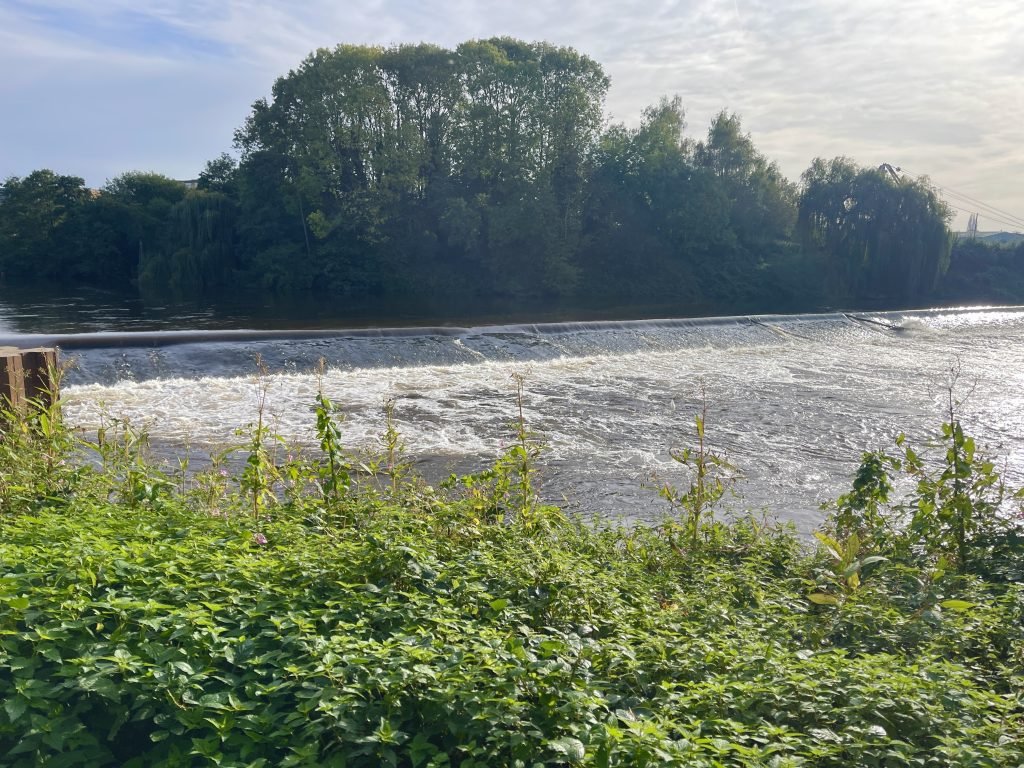
When planning your route, you should check in advance whether there are any weirs on the section of the river that you are going to kayak.
The safest practice is to exit the river well above the weir and to portage (which means carry) your boat around the weir and put back into the river a safe distance below the weir.
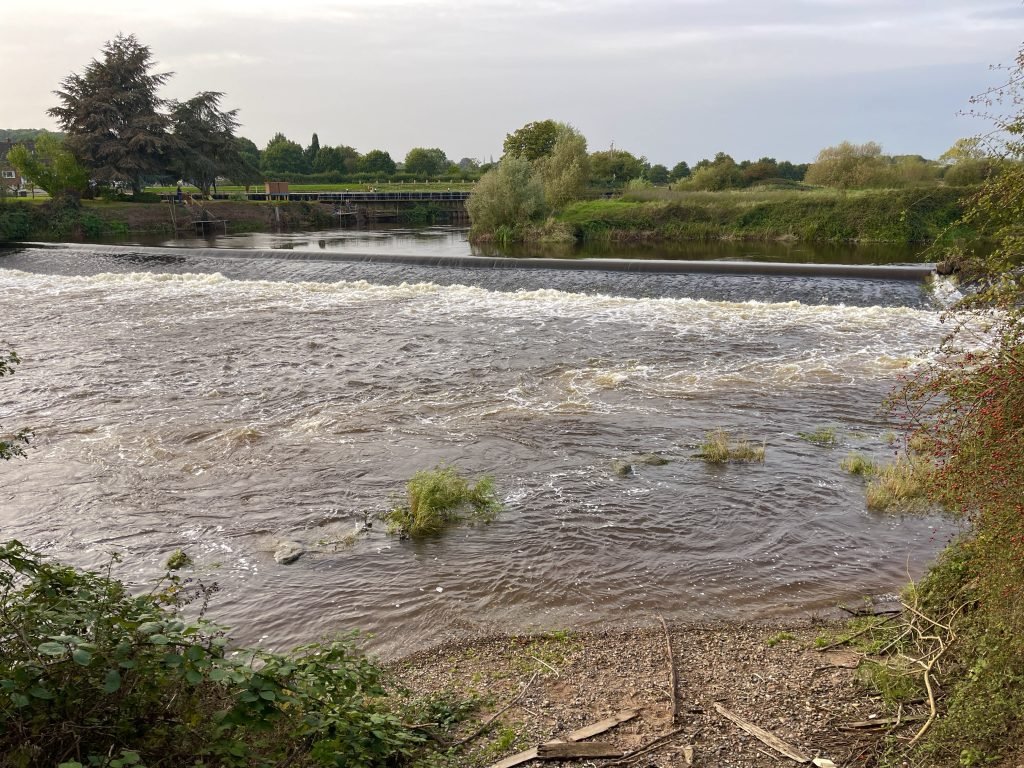
You should get out a safe distance upstream of the weir, because if you get too close to it then you may find yourself being pulled over the weir by the current which usually flows faster as you approach the weir.
Consider shooting the weir which means kayaking over it only if you are an experienced white water canoeist, in which case inspect and understand the hazards before deciding whether to paddle over the weir.
Some smaller weirs simply comprise a mound of boulders strung across the river.
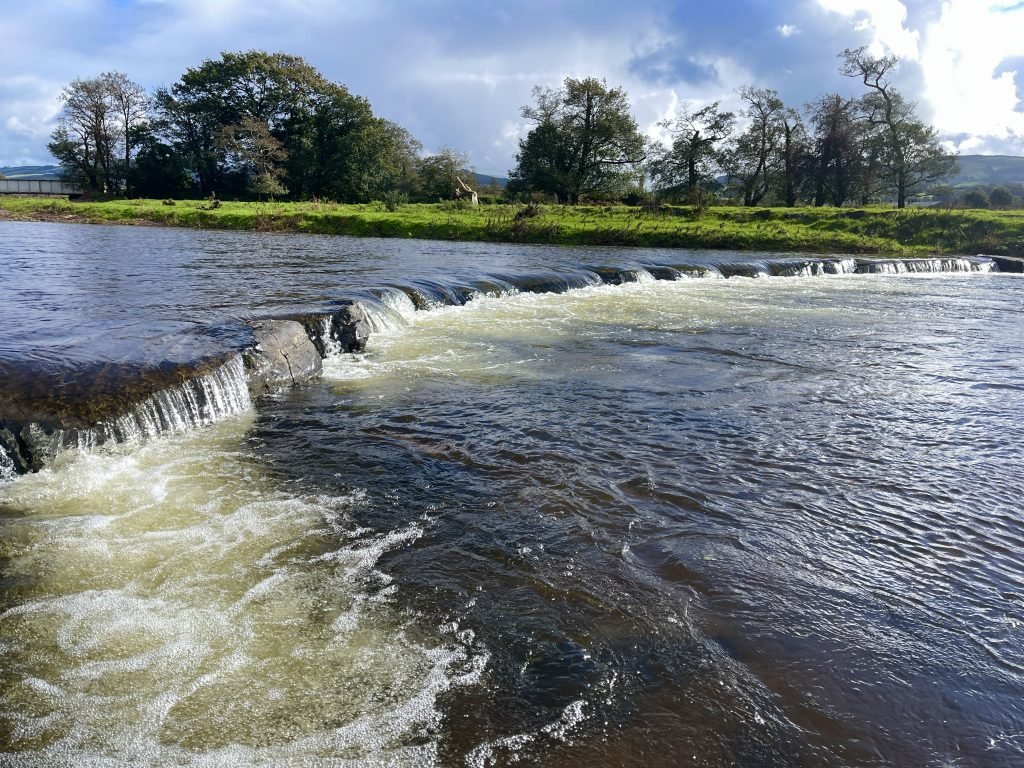
While not as potentially dangerous as full sized weirs, you should still check for your planned route for them in advance and we also portage around these smaller weirs.
Our innate sense of self preservation means we tend try and avoid anything which could potentially tip us out on the river
The greatest hazard is often the strong re-circulating flow (or towback) immediately downstream of a weir which can trap a person, animal or object, leading to exhaustion and drowning.

We would therefore very strongly reiterate that portaging around weirs on rivers is by far the safest and best practice.
2. RAPIDS
Secondly, you need consider the issues created by any rapids which will commonly be encountered when river kayaking.
Sections of rivers are graded from 1 to 6 depending on how difficult they are to paddle.
The higher the grade, the more skill and experience you will need as a paddler.
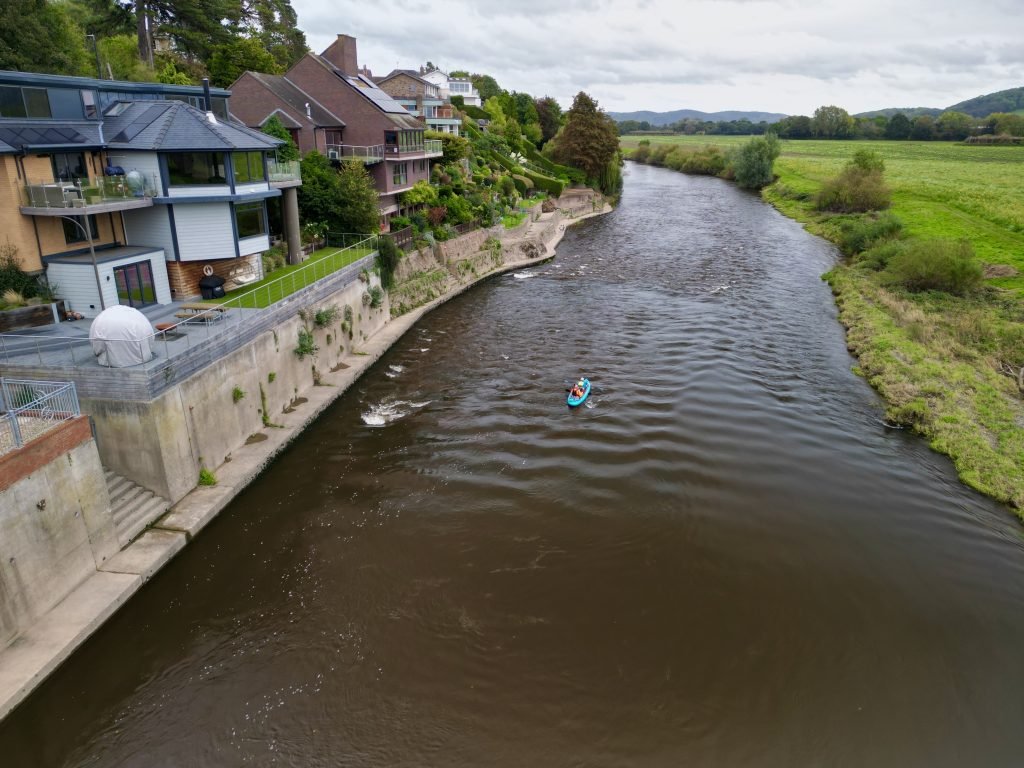
Note that with excessive or limited rainfall that river gradings can change.
Due to our cowardly approach to paddling, the Kayak Crew generally only kayak on grade 1 sections of rivers.
We generally prefer flatwater cruising on calm and steadily flowing sections of rivers although we do encounter some faster flowing sections on almost every river trip that we do.
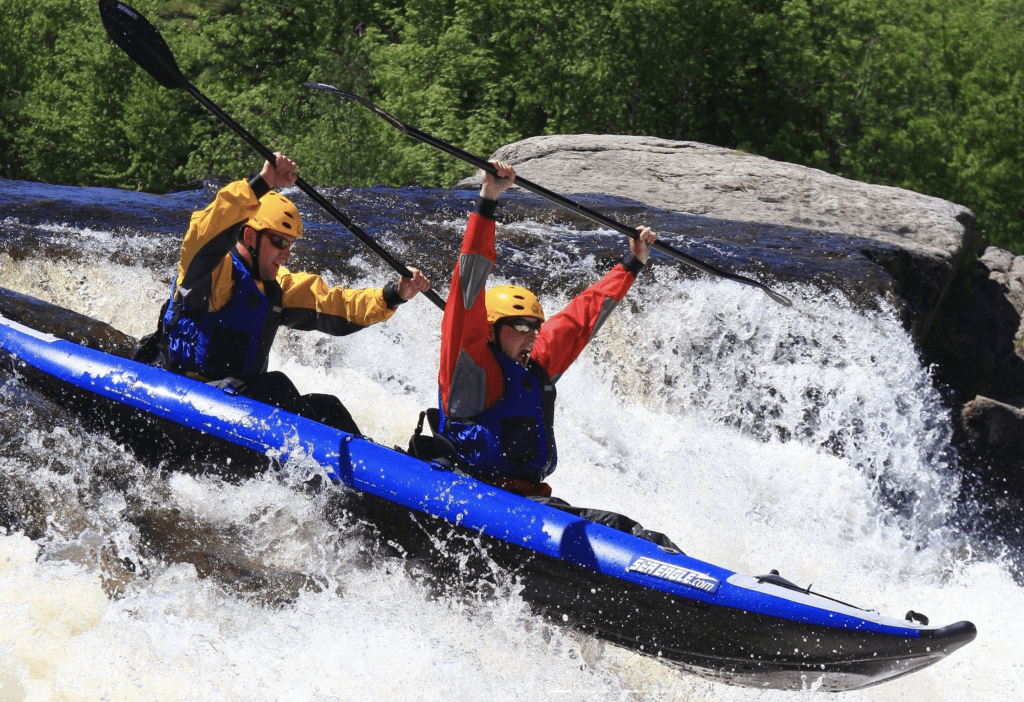
Once you start kayaking on sections of river graded 2 and above, then you really ought to have training on white water kayaking techniques due to the far greater element of danger.
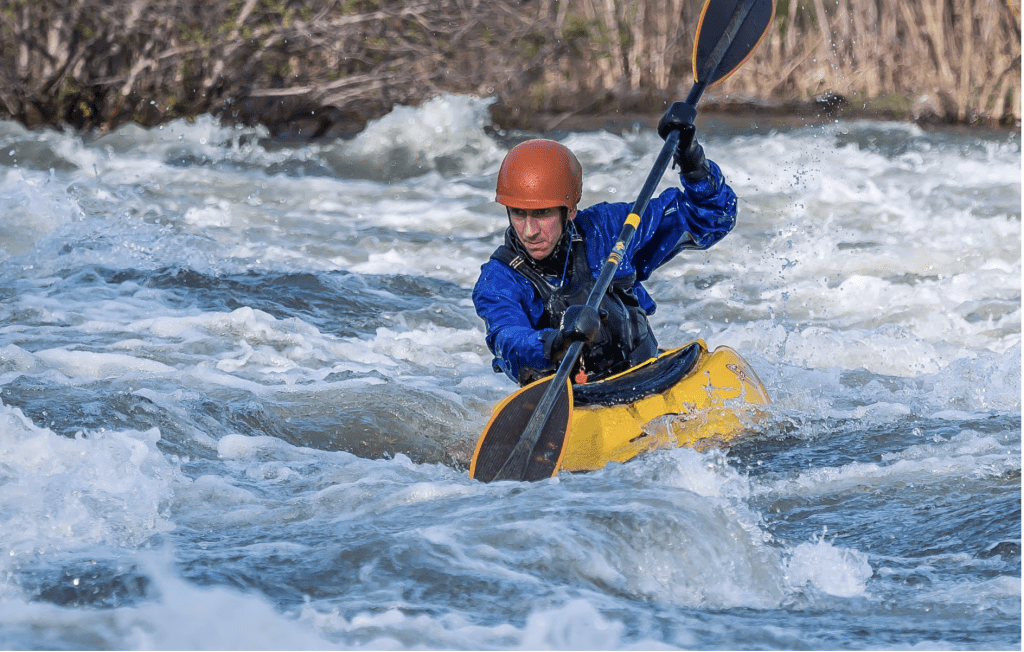
Additionally, you then need to start considering whether you need a kayak specifically suited to whitewater kayaking and should wear a helmet to protect your head and if paddling in the winter, you should wear a dry suit since you are far more likely to end up in the water.
3. OTHER DANGERS
Thirdly, there are all sorts of other potential dangers that you can encounter when river kayaking
Trees in the river
You may often encounter trees which have fallen into the river and become stuck on the riverbed.
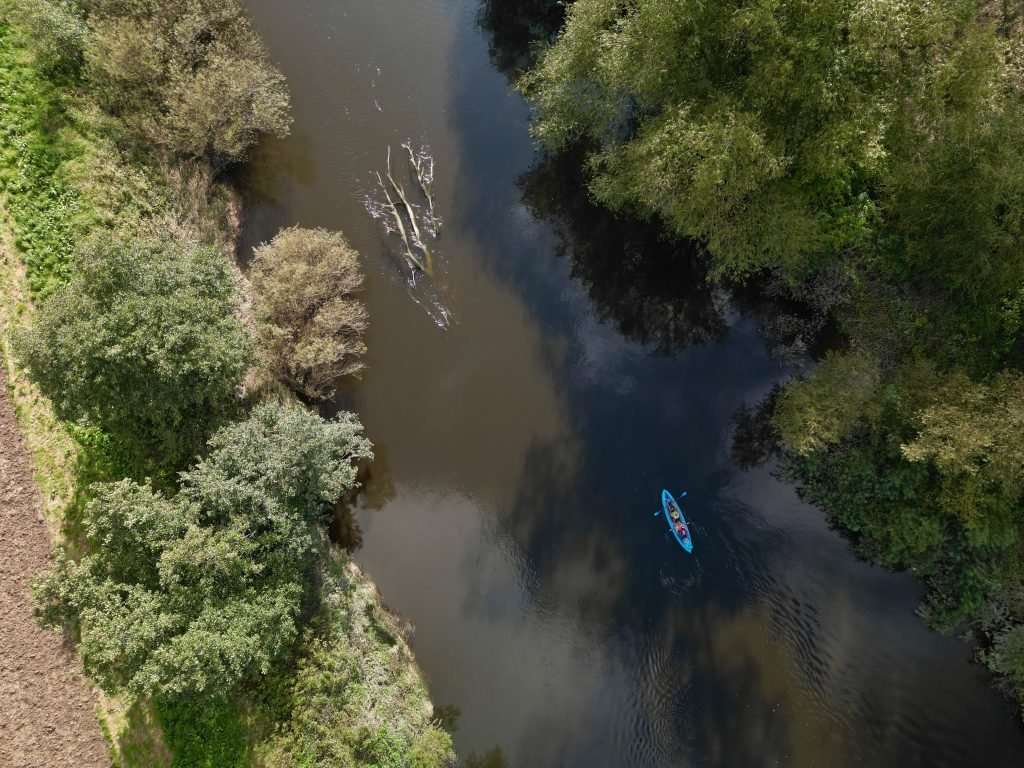
These could obviously present a potential danger if you crash into them and your kayak becomes tangled up.
Overhanging Branches
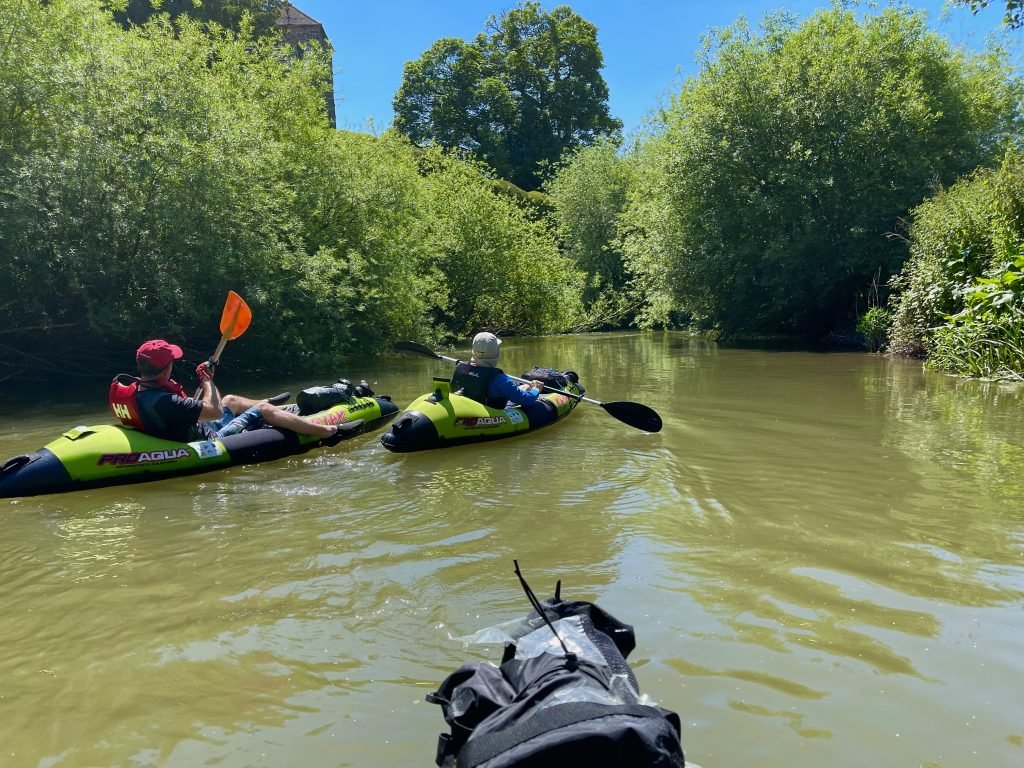
Another potential danger is that of branches of trees on the river banks which overhang the water which can drag you over if you kayak into them.
Boulders under the water
Another potential danger is that of rocks and boulders in the river.
Submerged boulders can be very difficult to see until it is too late to take any evasive action.
Learning to “read” the river will help to tell you which course to take through rapids.
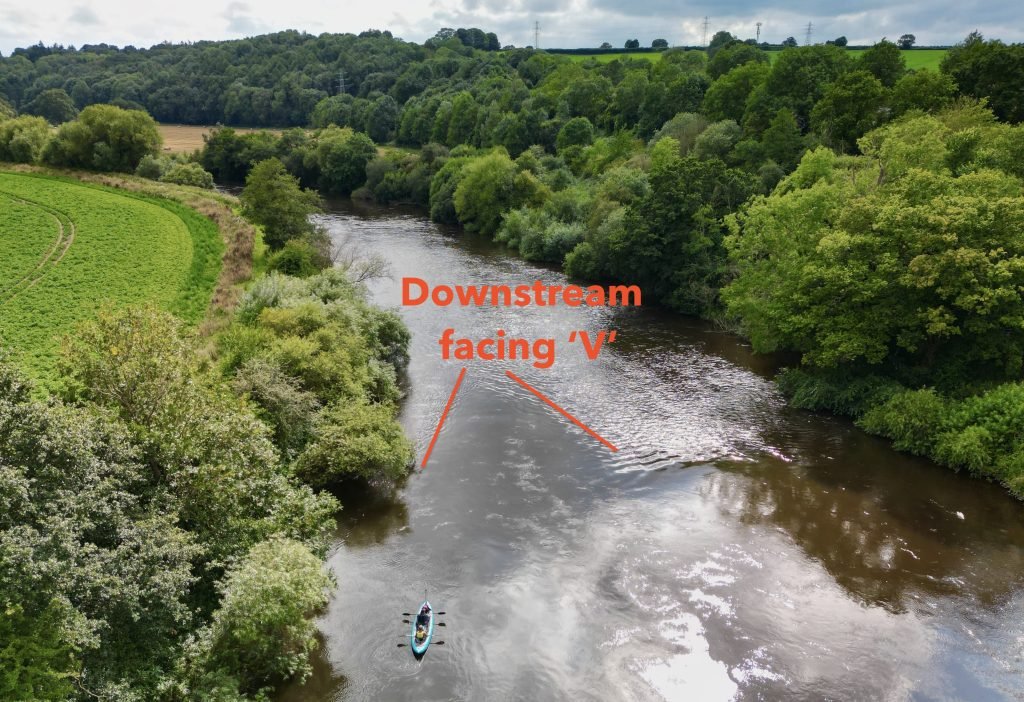
A down stream pointing “V”-shaped flow of smooth water indicates a clear channel through the rocks.
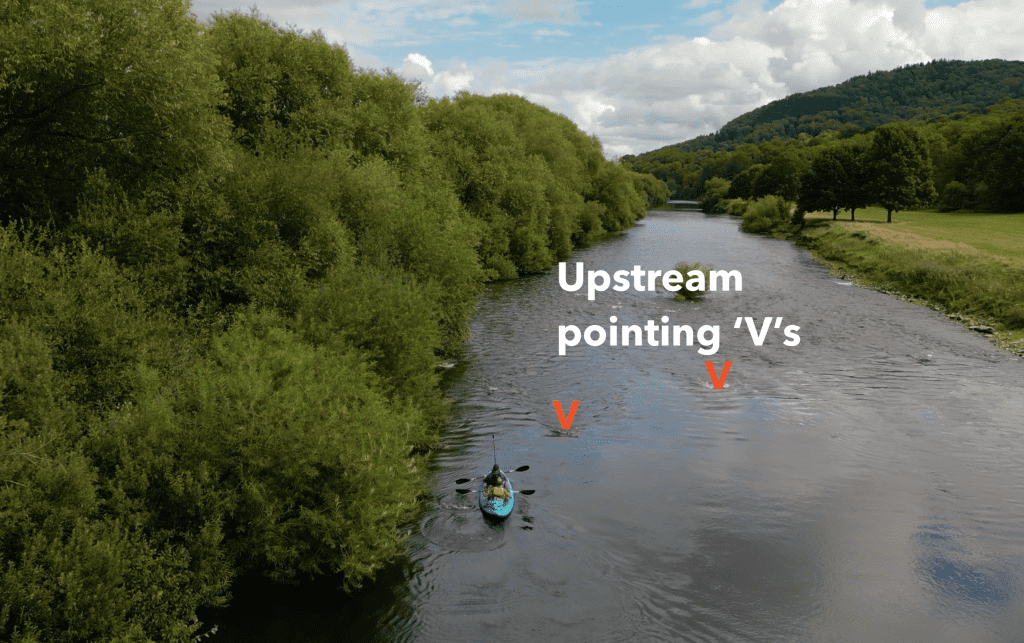
Conversely rocks lying just under the surface cause the water to tumble and form an upstream pointing “V”, warning you to give such an obstruction a wide berth.
If you collide with a rock then don’t lean away from it since the impact of hitting the rock could tip your kayak over in the direction you are leaning.
Instead, lean into it and push off of it with your hand.
Other obstacles in the river
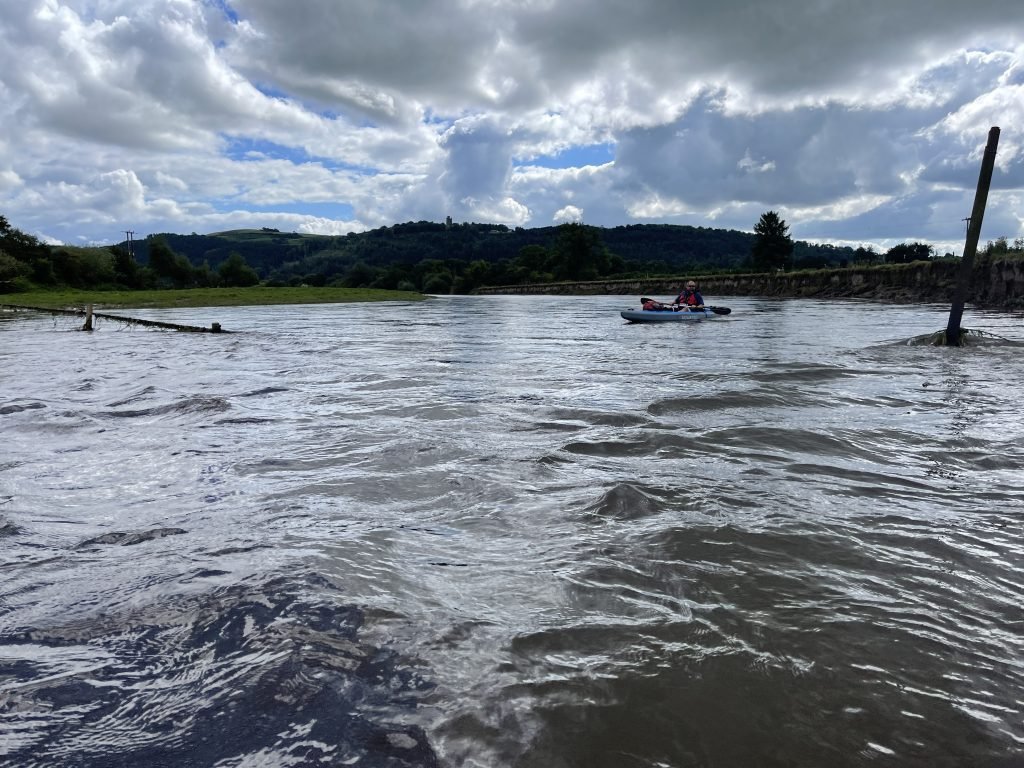
There can be all sorts of other obstacles to watch out for in the river, including supermarket trolleys, sections of agricultural fencing and other items.
Foot Entrapment
Foot entrapment is when your foot gets stuck in between rocks or some other obstruction on the river bed, such as when you fall out of your kayak.
4. RIVER LEVELS
We would suggest that you always check the water level of any non-tidal river before you plan a kayak on it.
We use the website riverlevels.uk which has live readings for gauging stations along most rivers.
It’s important to check that the water level is not so high as to make the river potentially dangerous to paddle on the day when you intend to go due to the volume and speed of the flow. This can often happen after heavy rain.
The water levels are generally safe when they are comfortably within the ‘normal’ range which comprises the green part of the gauge graphic.
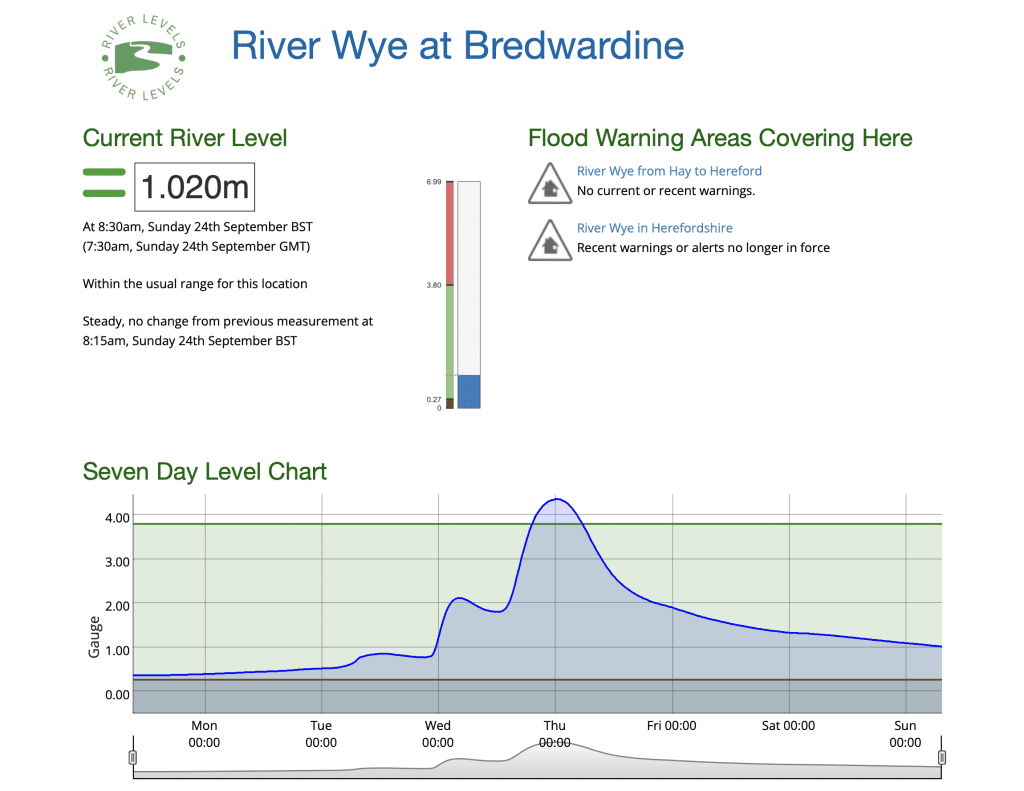
If the water level is near or in the red zone, it will likely be very dangerous to paddle the river because of excessive water flows.
At the other end of the spectrum, we have also paddled once on the Wye when the water level was very low, in the brown segment below the usual range and we found ourselves hitting lots of rocks under the water and bottoming out a lot because the river was too shallow.
5. PLAN YOUR ROUTE
Having a map of your intended route is important for a number of reasons.
In particular, you need to have an idea of:
- how long the route is
- roughly how long it’s going to take you,
- where you are going to launch and land, and
- whether there are any weirs or other obstacles along the route
We use OS Maps to plot all of our routes before we go.
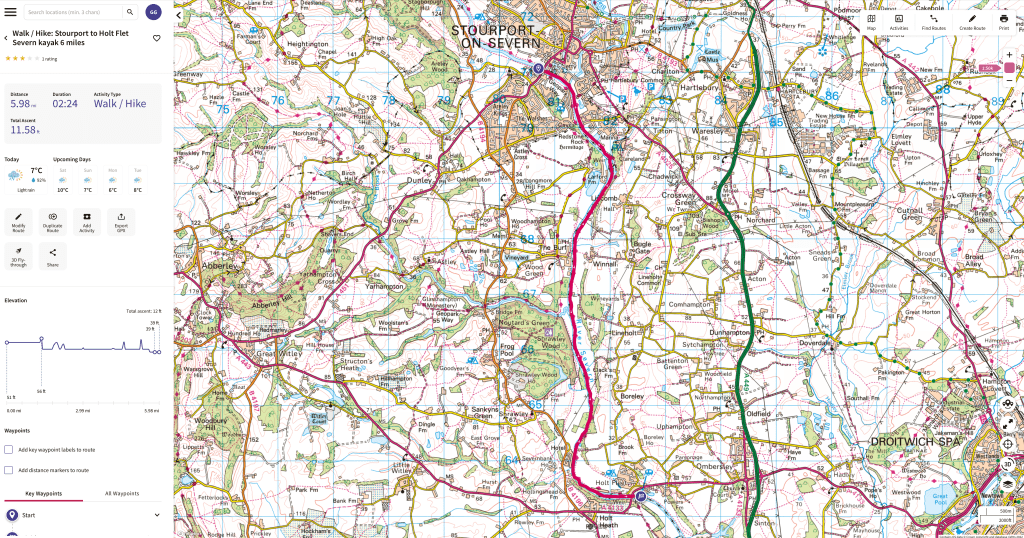
OS Maps is of course specific to the UK but if you live in other countries then we’re sure that you have similar services that you can use to plot your proposed routes to see what distances they are.
We generally use inflatable kayaks so we can take them on buses, trains or in taxis since when deflated they pack into large backpacks.
The alternative is of course to leave a vehicle at either end of your route, which is what we often do even if we are just using our inflatable kayaks.
6. ACCESS TO THE RIVER
The banks to rivers are generally privately owned and therefore you need to plan in advance where you are going to be able to launch from and land your kayak.
You will usually be using at least one vehicle for your kayak so parking near to your launch and landing locations also needs to be factored in.
There are several ways of finding out where the launch and landing locations along the river are.
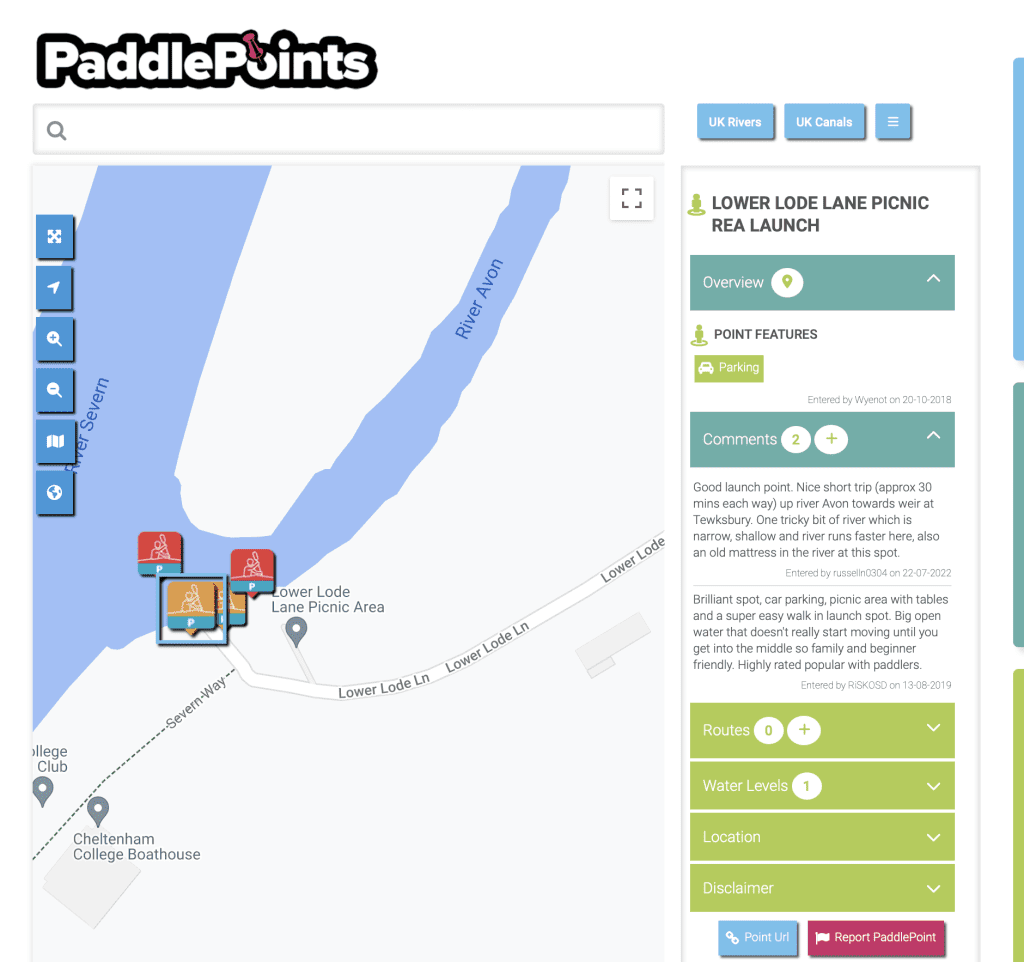
The Gopaddling.info website has a feature called Paddle Points which is really useful for finding locations along rivers where you can launch or land together with information about weirs, parking and other potential obstacles along the route.
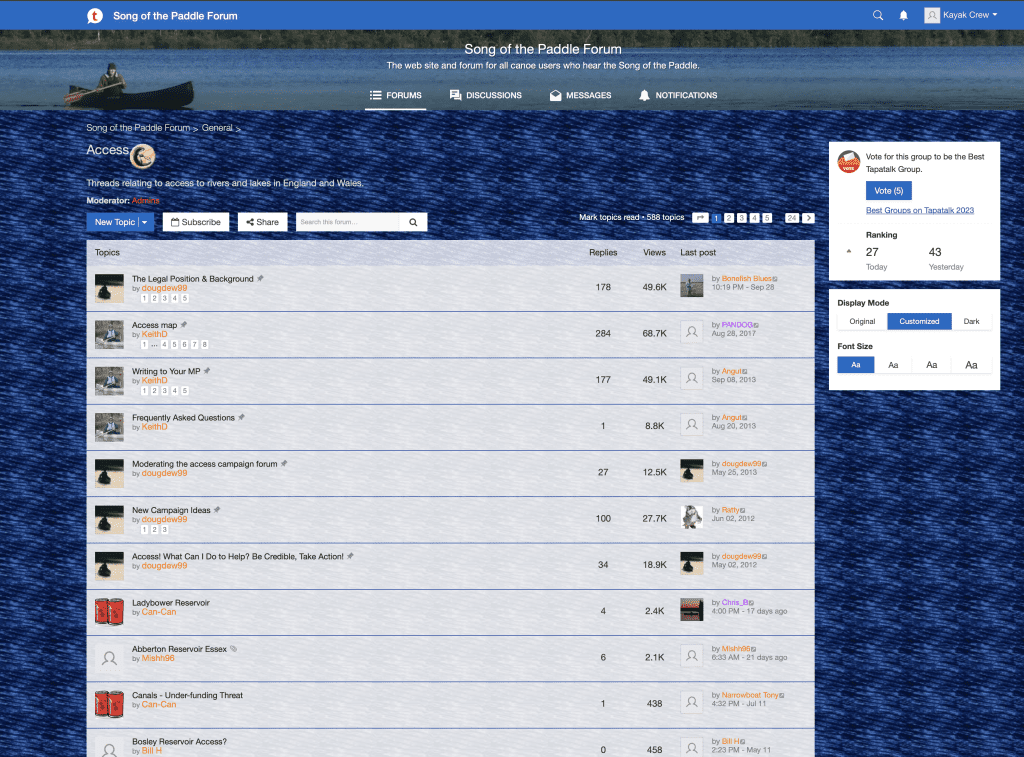
Another useful website we often use is songofthepaddle.co.uk which has a forum on which you can search for posts relating to a particular section of river that you intend to paddle to try to find useful information such as access issues.
You can also find guides online relating to particular rivers which are popular with kayakers, such as the Wye River, the Severn River and the Thames River.
Finally, there are guidebooks relating to some rivers and we have purchased some of the excellent guide books written by Mark Rainsley.
7. TIDAL RIVERS
Tip 7 relates to tidal rivers. Most rivers become tidal as they near the coast.
Some rivers have a tidal range which extends many miles inland.
Where they near the coast, rivers usually become estuarine.
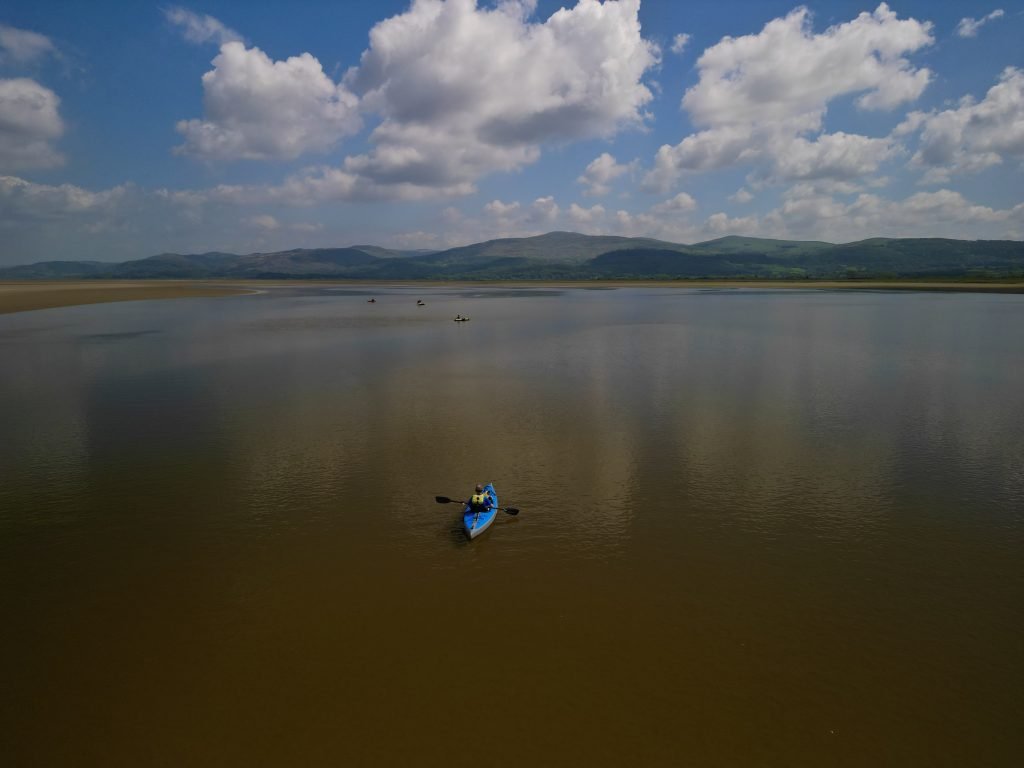
We have done a separate video on our channel and a blog post on our website specifically aimed at kayaking estuaries.
Here, we simply summarise some of the main factors which need to be taken into account with tidal sections of river.
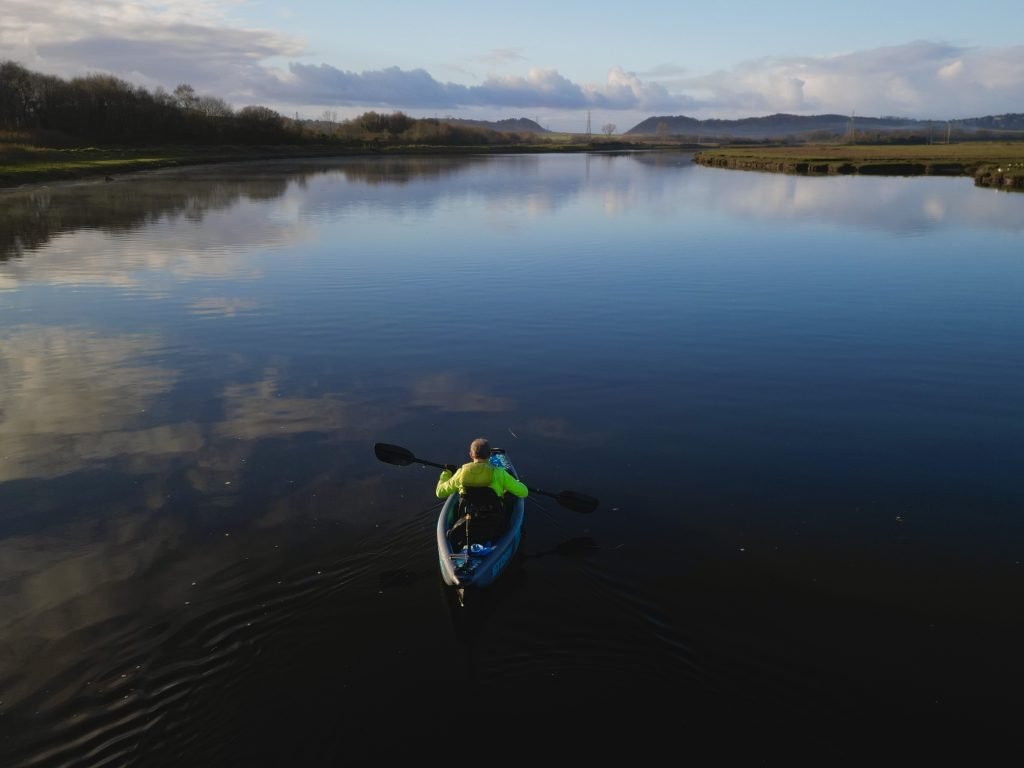
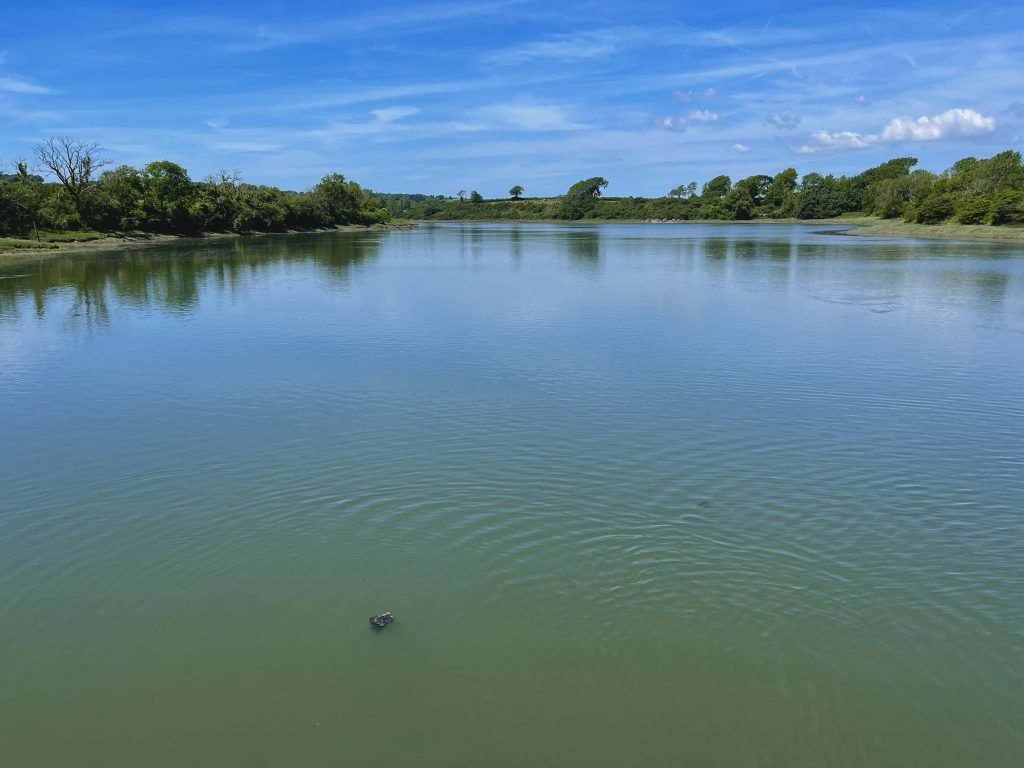
Many tidal rivers and estuaries have a big tidal range and it’s often only feasible to launch or land on them within 3 hours or so of high tide.
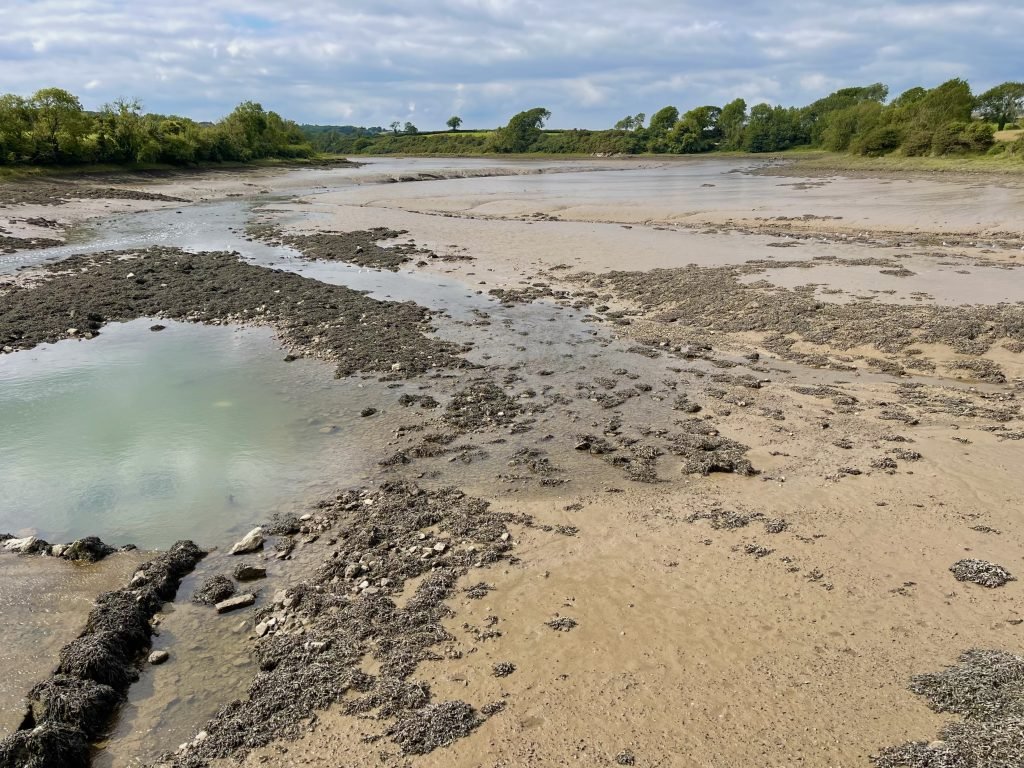
When the tide drops lower, these launch or landing locations can often become difficult or impossible to access due to them becoming separated from the water’s edge either by large tracts of sand, or by swathes of estuarine mud, or sometimes even both!
When paddling tidal rivers and estuaries, you generally have to paddle with the tide, either upstream with the incoming tide or downstream with the outgoing tide.
You therefore need to check the tide times before paddling such tidal rivers.
8. WHICH RIVERS CAN YOU PADDLE?
Regarding sections of rivers above the tidal limit, these fall into 2 categories:
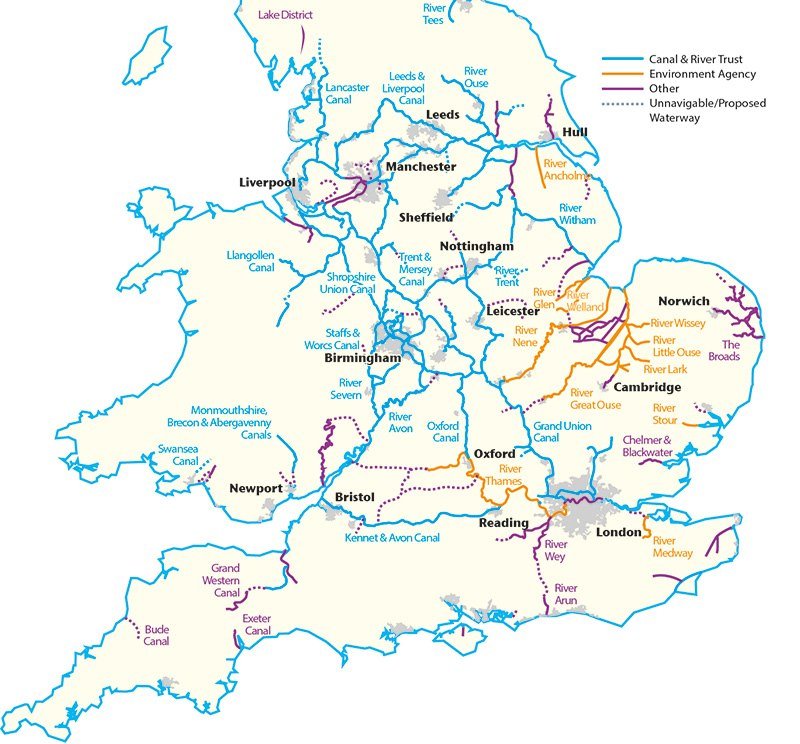
Rivers where there is a public right of navigation
There is an established public right of navigation on large sections of many rivers in England and Wales.
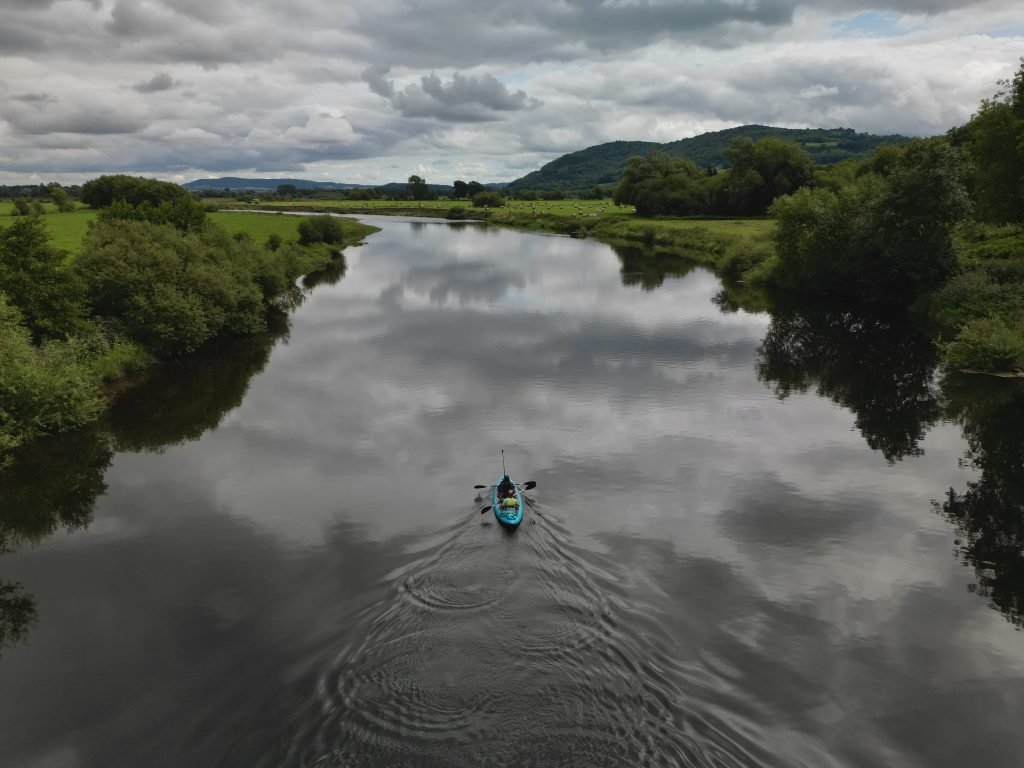
Some sections of river where there is a right of navigation require you to have acquired a waterways license.
Membership of British Canoeing or Canoe Wales includes the Waterways Licence which entitles you to paddle 4,500 kilometres of waterways in England and Wales.
Rivers with NO public right of navigation
Where there is no established public right of navigation on the section of river in question then the position in England and Wales is slightly unclear.
British Canoeing’s website states that they believe that there is a strong case to demonstrate an existing right of navigation on all navigable rivers.
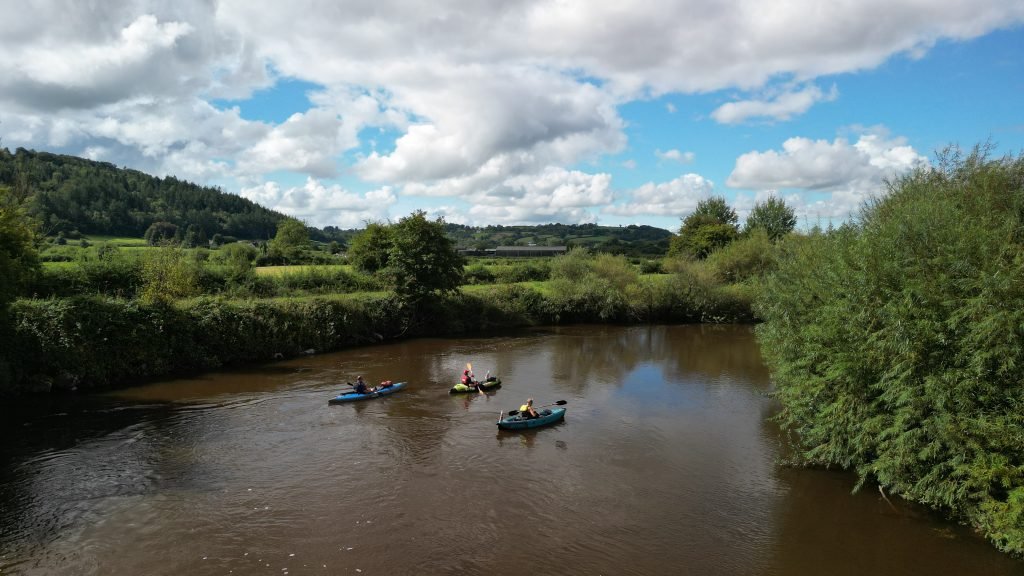
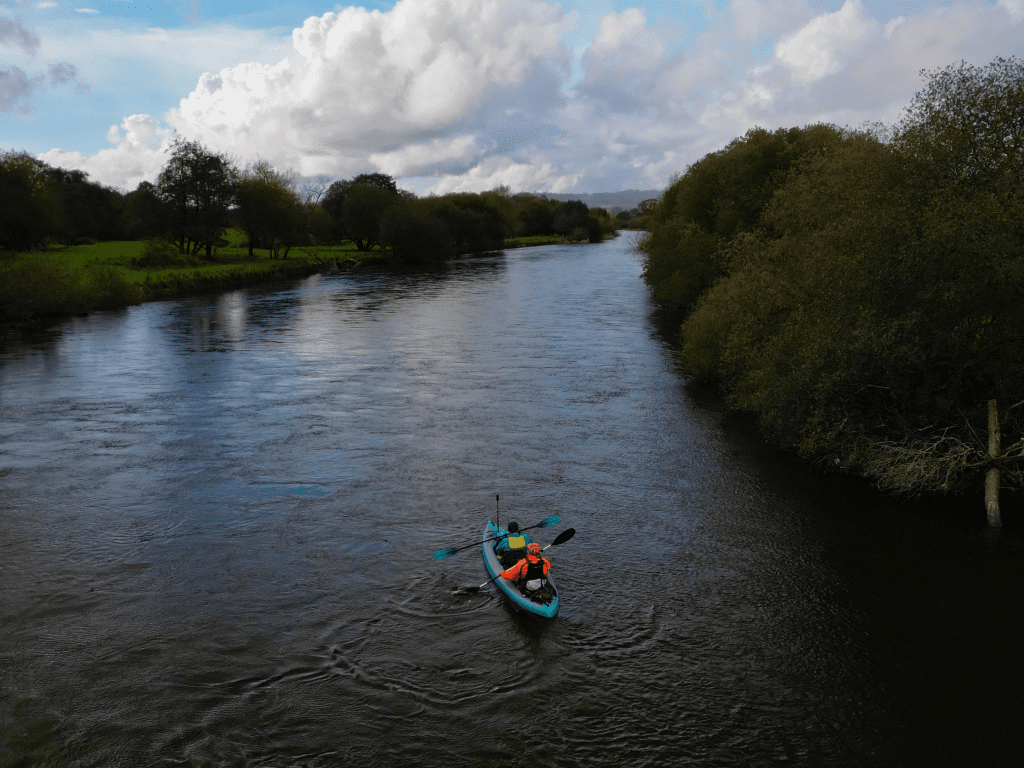
However, many landowners believe that rivers are private and require permission from the landowner before paddling.
We tend to kayak such sections of rivers outside of the fishing season to avoid any potential conflict wit anglers or others.
Kayaking on tidal rivers
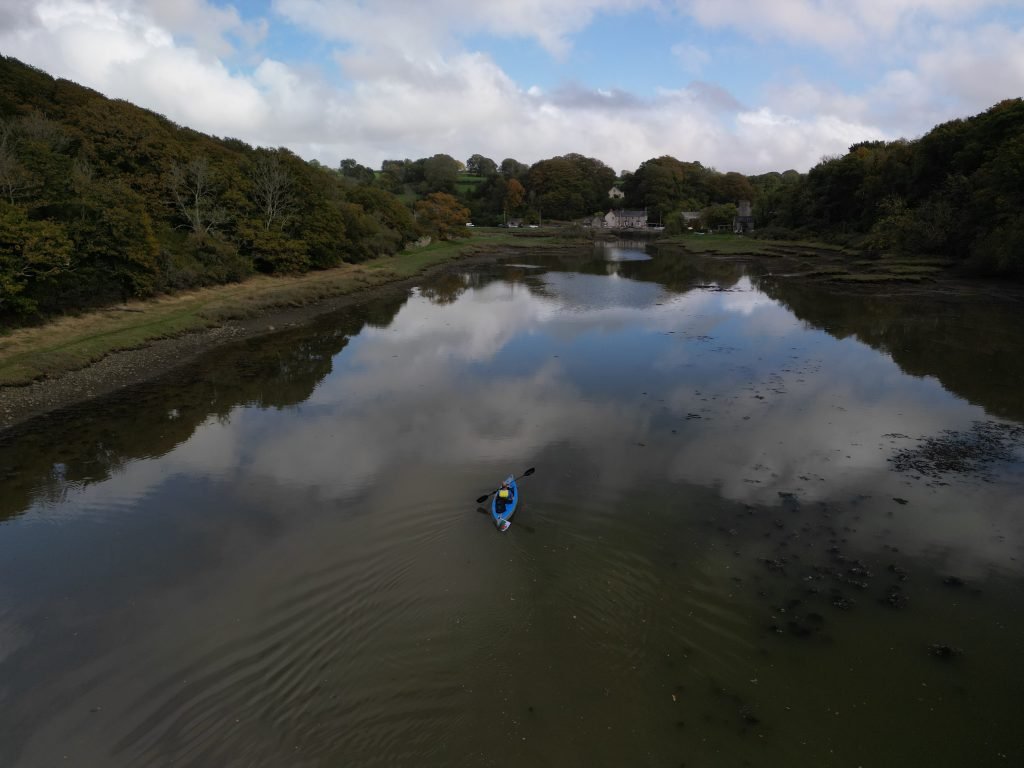
Any tidal area in the UK is generally owned by the Crown, and as such the general public have a presumed right of navigation up to their historic Normal Tidal Limit.
9. CURRENTS AND FLOW
Tip number 9 concerns the main issues relevant to currents and flows in rivers.
Eddies
There are two parts to a river: the main current and eddies.
Eddies are the calm spots formed by obstructions in the water, like boulders, narrow points or islands.
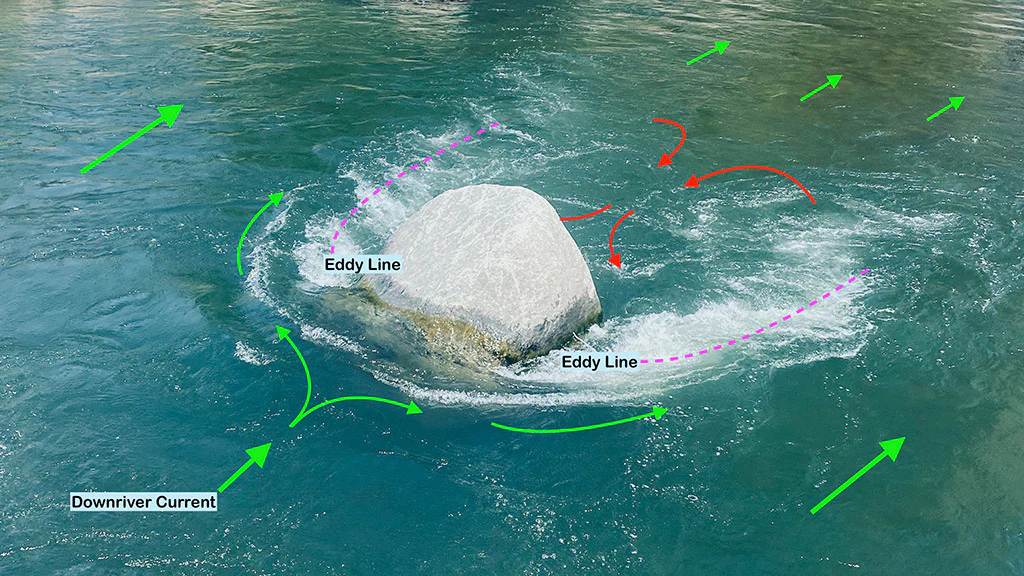
Eddies are safe zones where you’re protected from the main current.
Where the current and eddy meets, though, eddy lines form and these are the most unstable water of the river.
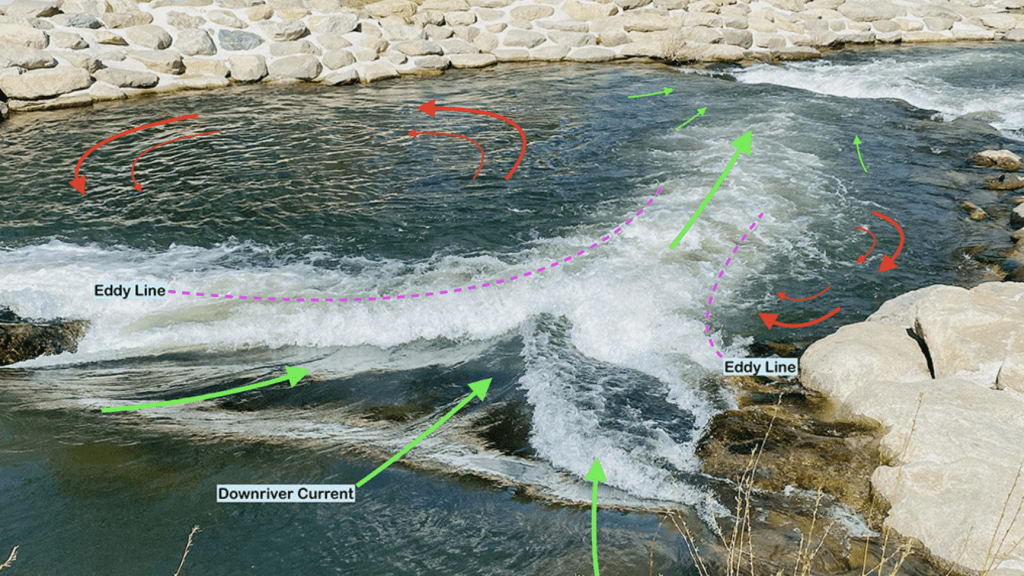
You’ll want to spend your time either in the main current or in the eddies. When you paddle across and eddy line you should lean a bit into the natural turn of your kayak as you cross the eddy line.
Waves
Standing waves are formed when there is a lot of water flowing over the rocks.
Waves are usually friendly and fun to run.
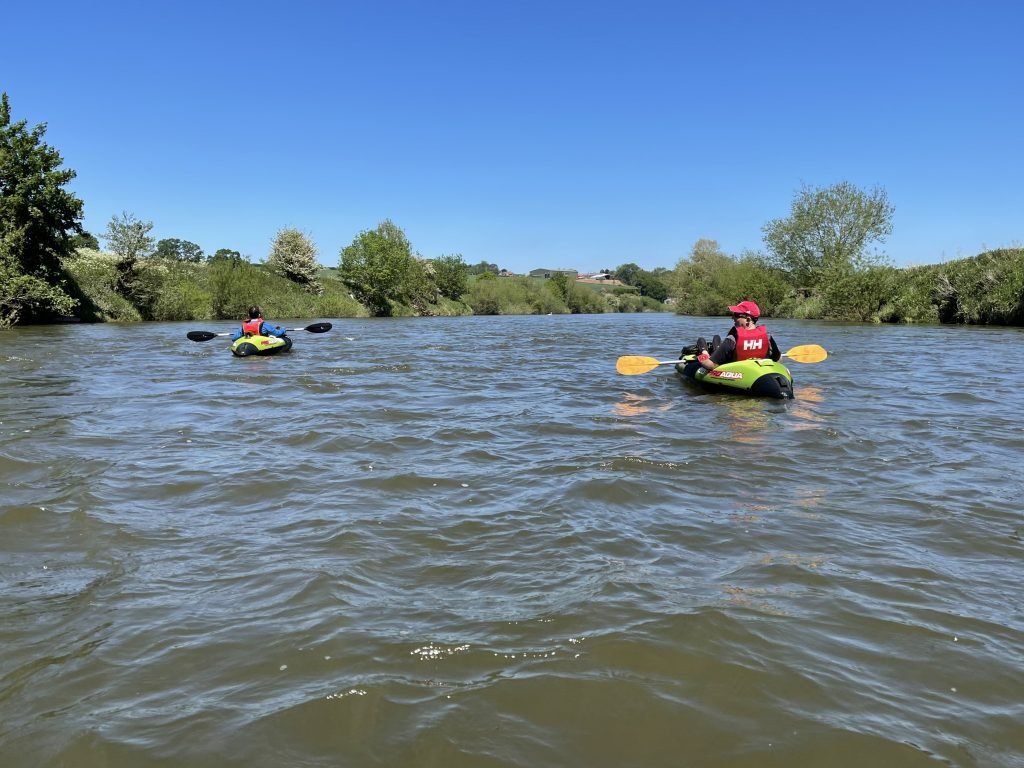
They do act on your kayak with a force pushing back upstream so it’s good to paddle enough so that you maintain a speed that is faster than the current.
Holes
Holes aren’t as friendly as waves, and it’s best to avoid them.
A hole is created when there is a steep drop of the water behind the rock which creates a strong back current flowing upstream.
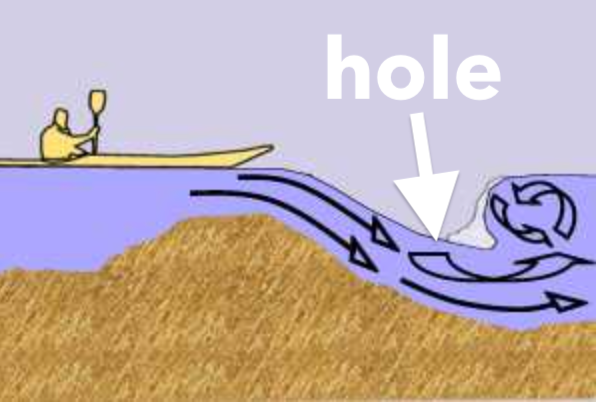
Holes may look similar to waves but the big difference is that in a hole, a lot of the water in the foam pile is flowing upstream.
10. EQUIPMENT & CLOTHING
This is by no means an exhaustive list of equipment and clothing but it covers what we feel are the most important items for river kayaking
Kayaks for River Paddling
Regarding the question of what kayaks are suitable for river kayaking, you can pretty much use any type of kayak for flat water cruising on rivers.
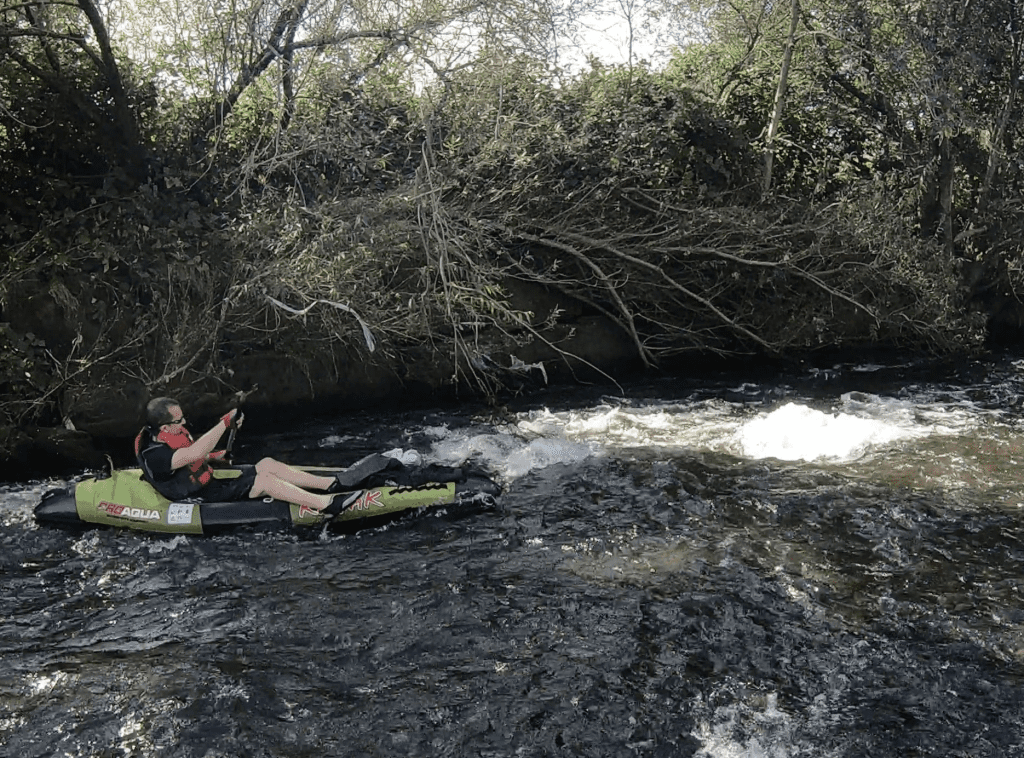
We generally use inflatable kayaks.
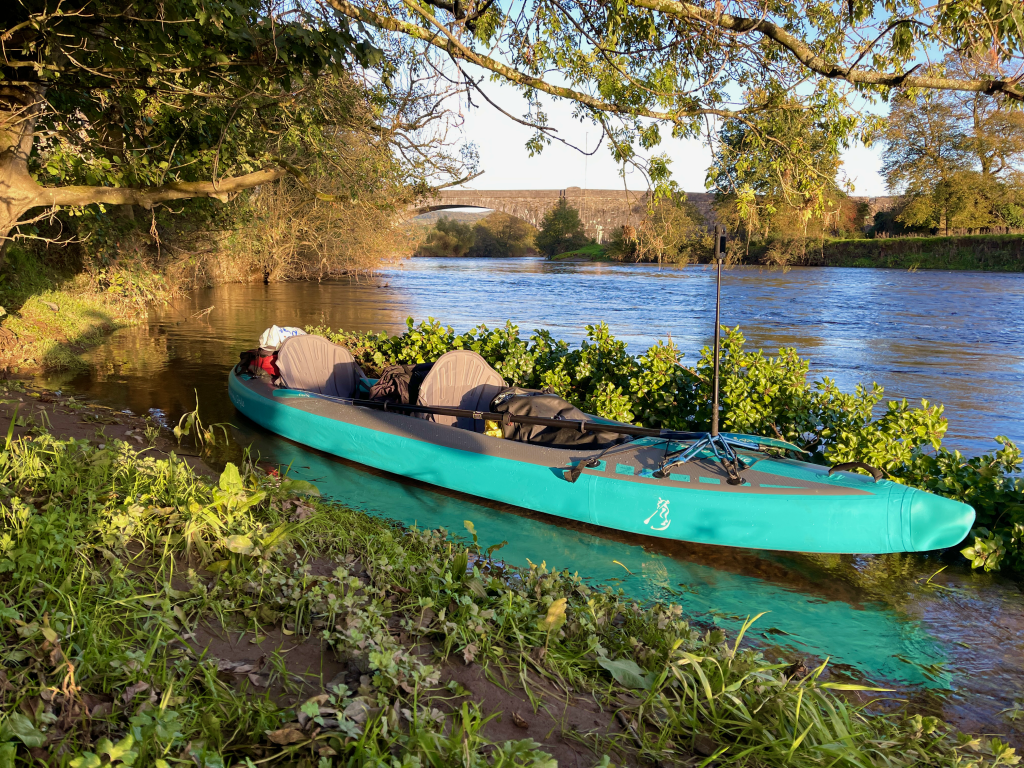
We often use clamshell shape full drop stitch kayaks such as the Sandbanks Optimal. These are stable, robust and easy to get into and out of.
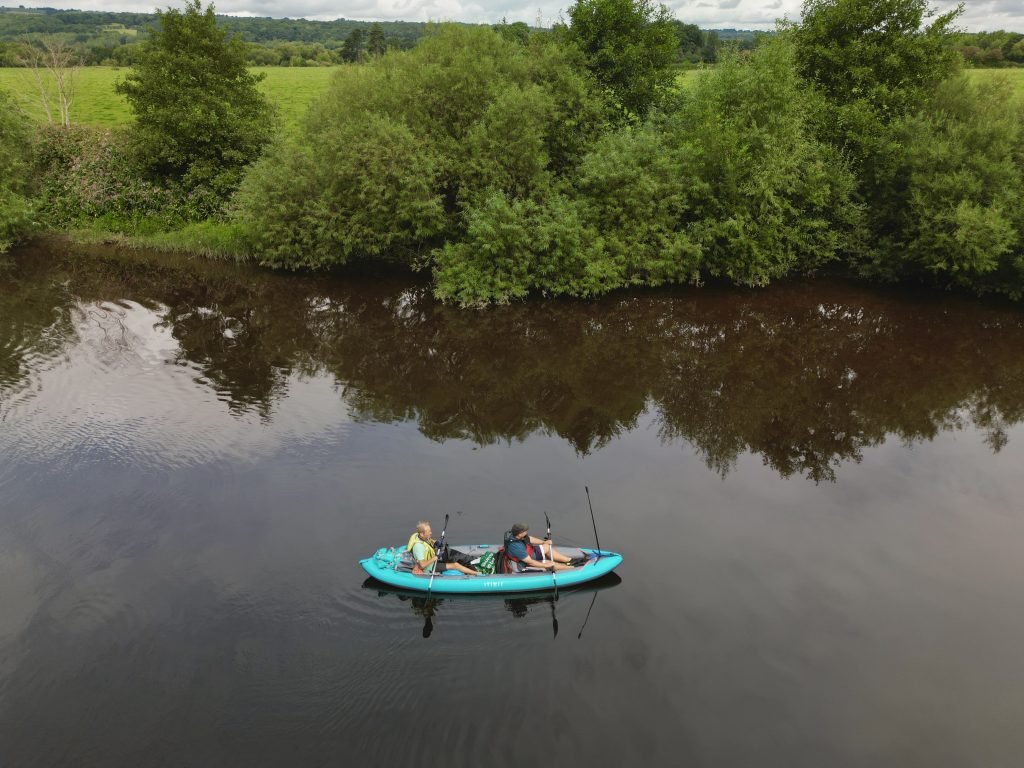
We also use single skin pvc kayaks which have a drop stitch floor but tubular sides, such as the Itiwit X100 which are also stable platforms for river kayaking.
If you intend to do a lot of whitewater paddling on rapids of Grade 2 or above, then you really should be considering a robust, whitewater specific kayak.
Personal Flotation Device (PFD)
Personal Flotation Devices or PFD’s are safety items which will assist you in staying afloat if you end up in the water.
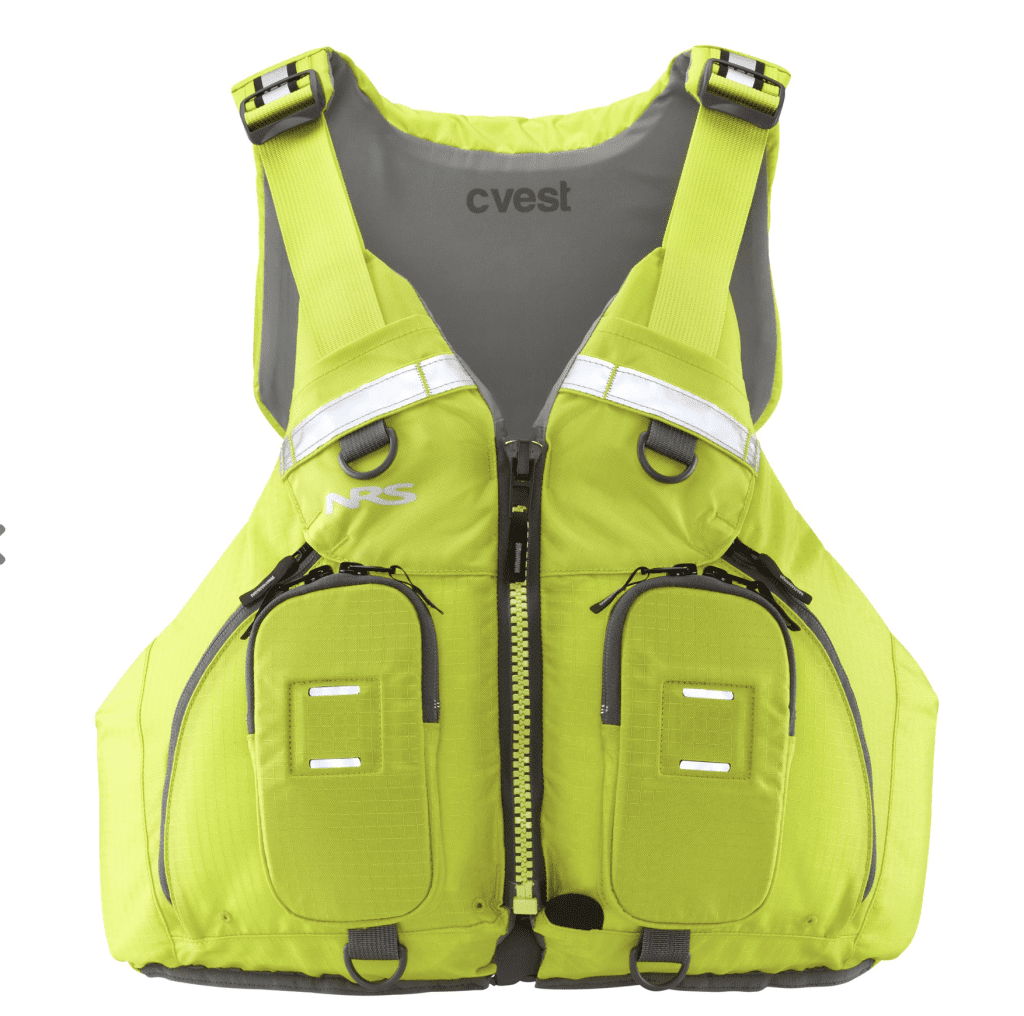
We prefer the high back PFD’s such as the NRS cVest Mesh Back since the back padding sits above the top of your kayak seat.
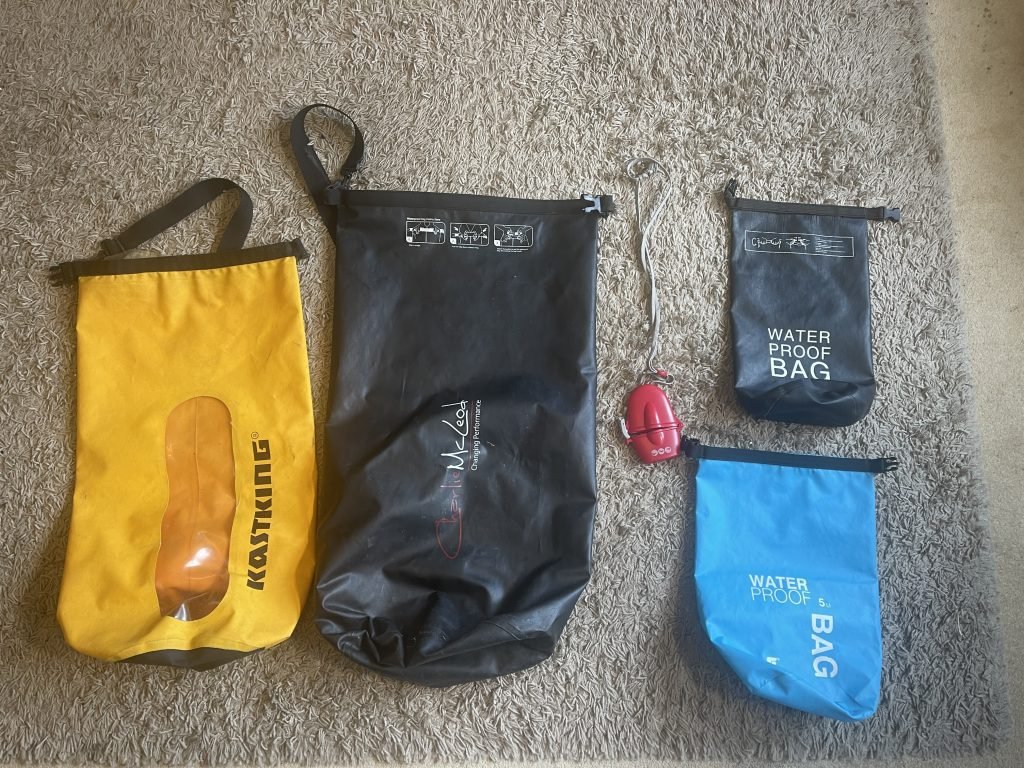
Dry Bags
Dry bags are extremely useful for keeping things like electrical items, clothes or food dry when you go out kayaking.
Helmets
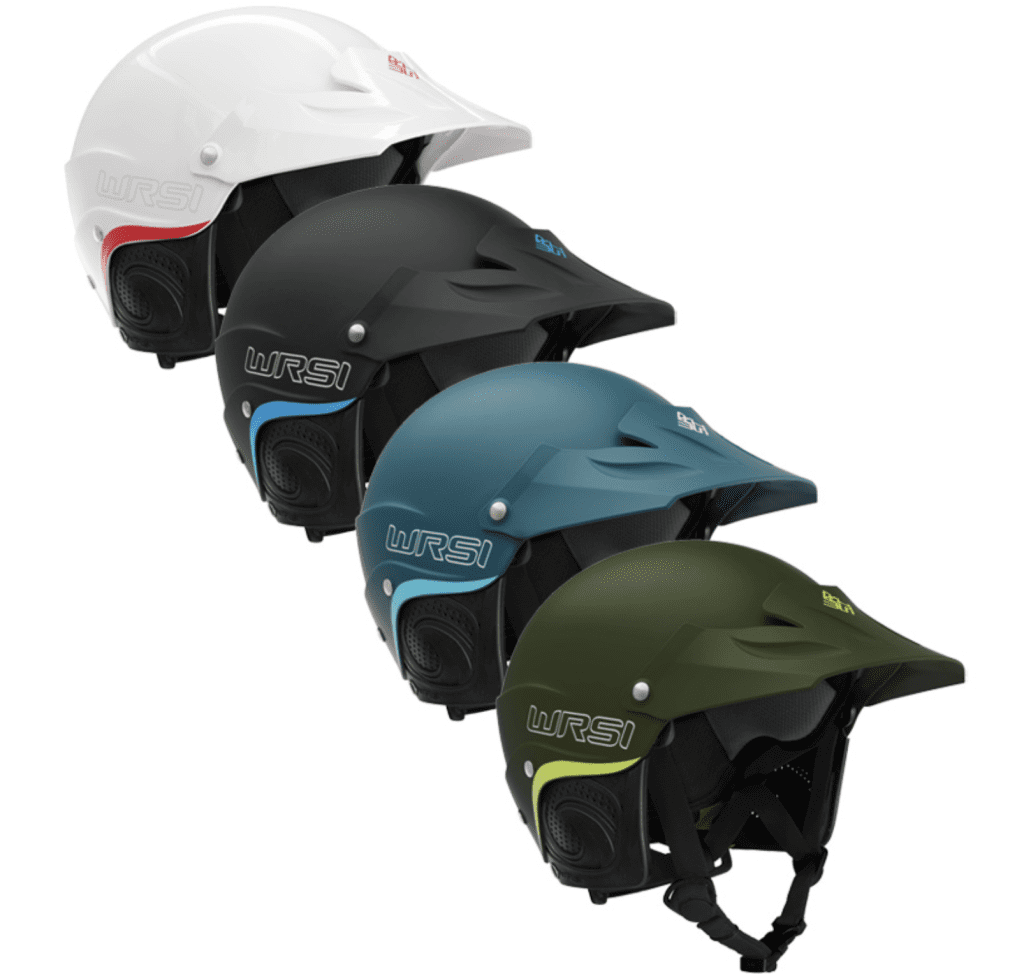
If you are going to be paddling on rapids graded 2 and above then it is essential to wear a kayaking helmet to protect your head.
Clothing
If paddling rivers in colder conditions then dry suits, semi dry suits, or dry jackets and dry trousers are advisable.
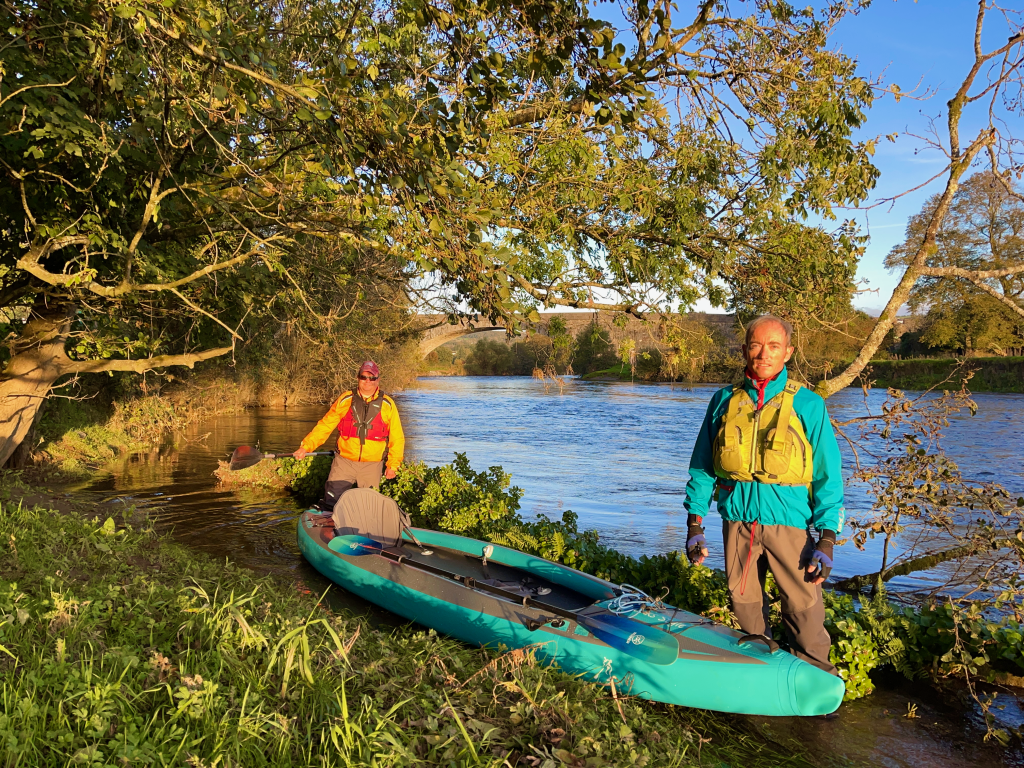
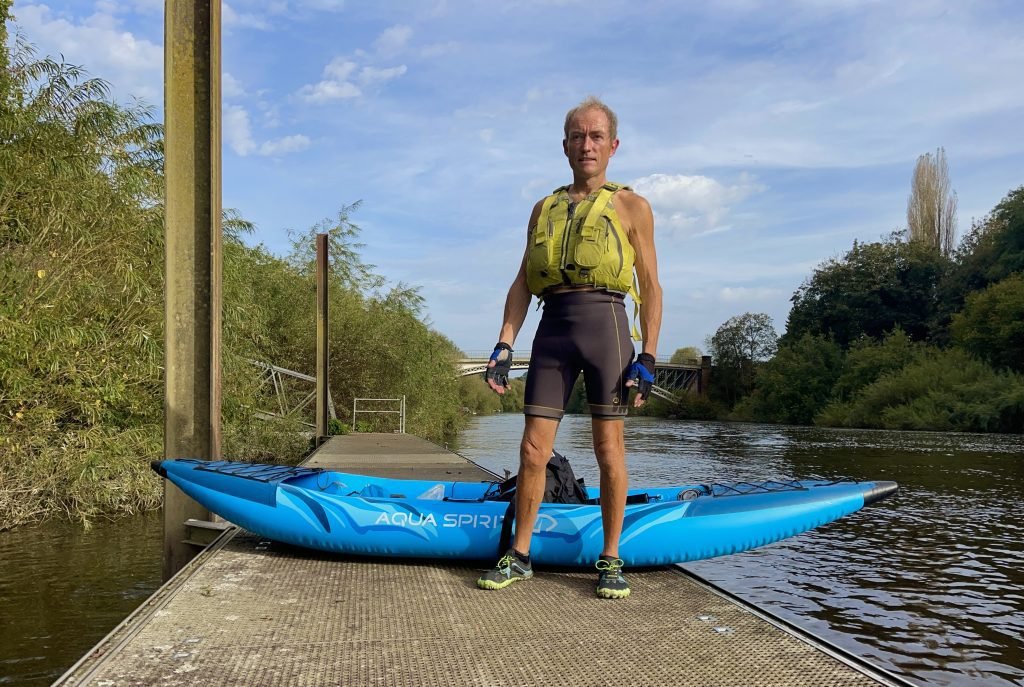
When it’s warmer, its simply a case of wearing what suits you but you still need to be prepared for it potentially getting colder throughout the paddle and it’s always worth taking a couple of extra layers to put on if needed.
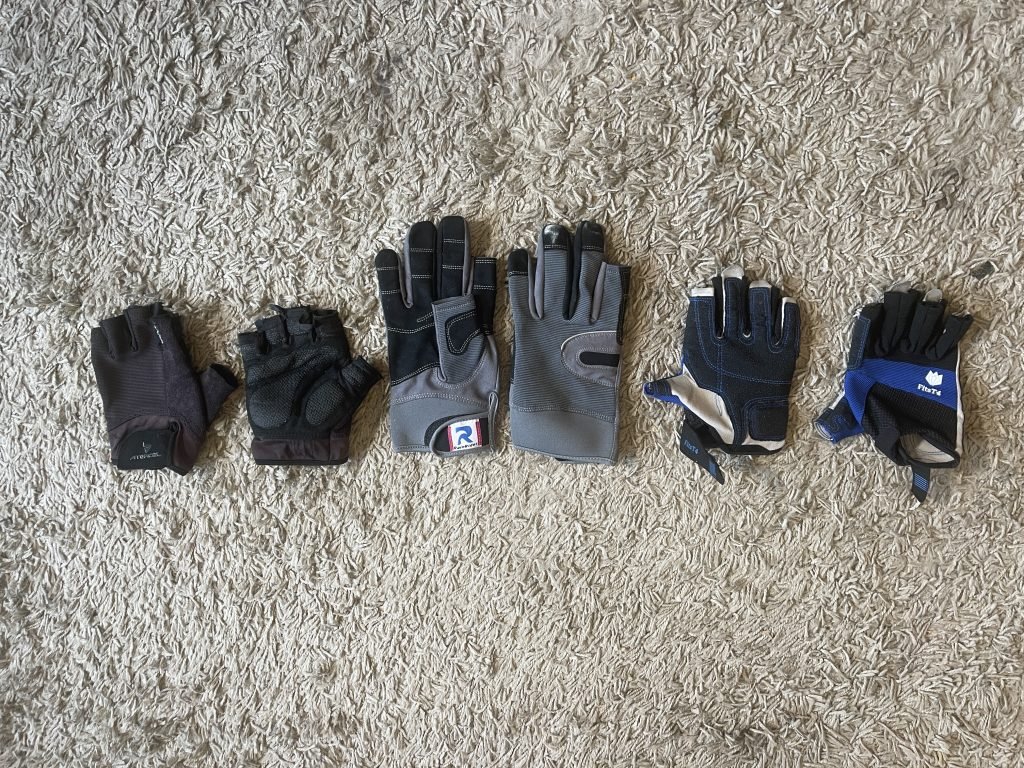
Gloves
Good kayaking gloves are well worth investing in, since you can otherwise get blisters on your fingers after a few hours which can be quite painful.
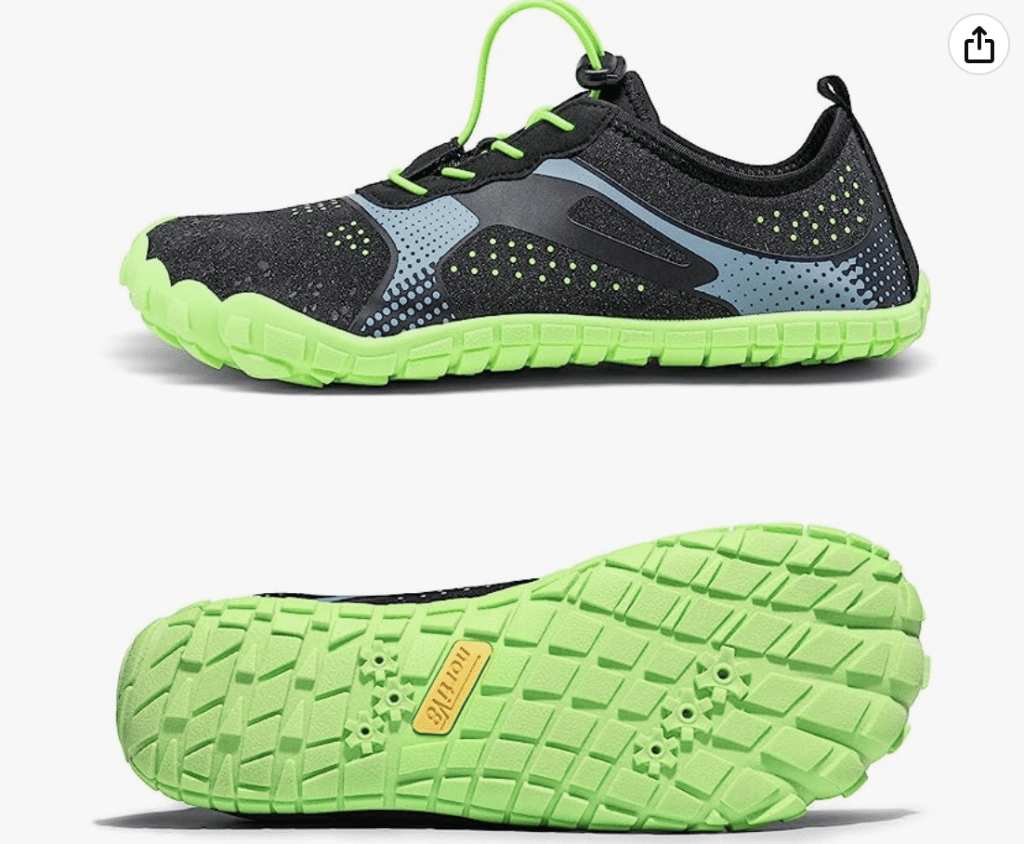
Footwear
As for footwear, in the summer we usually wear water shoes with neoprene socks underneath them.
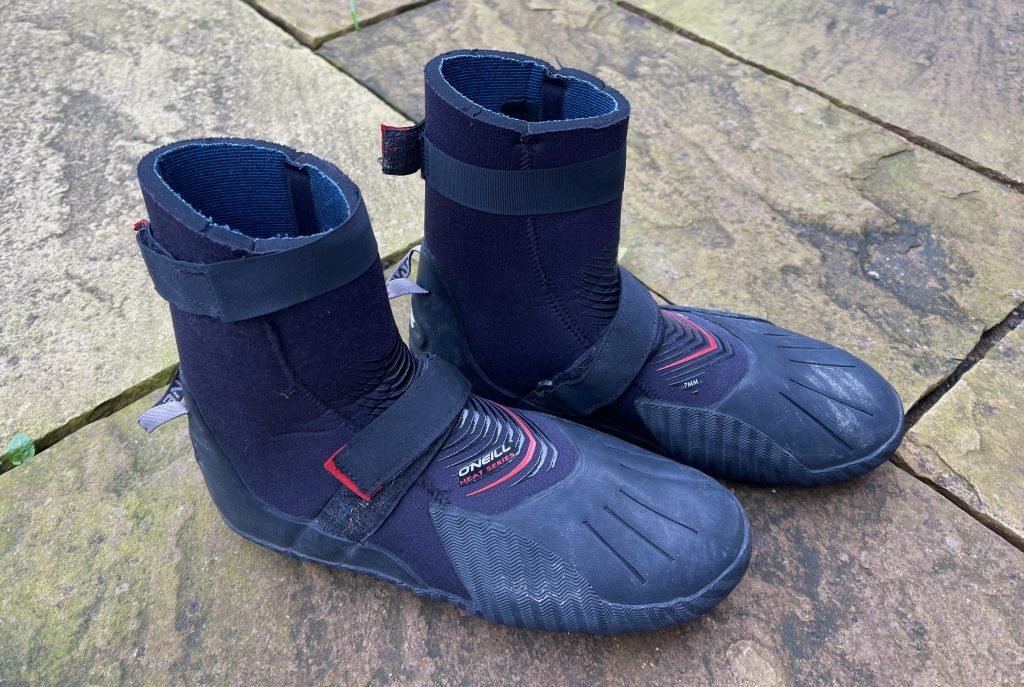
In the Winter, we usually wear thick neoprene boots on our feet.
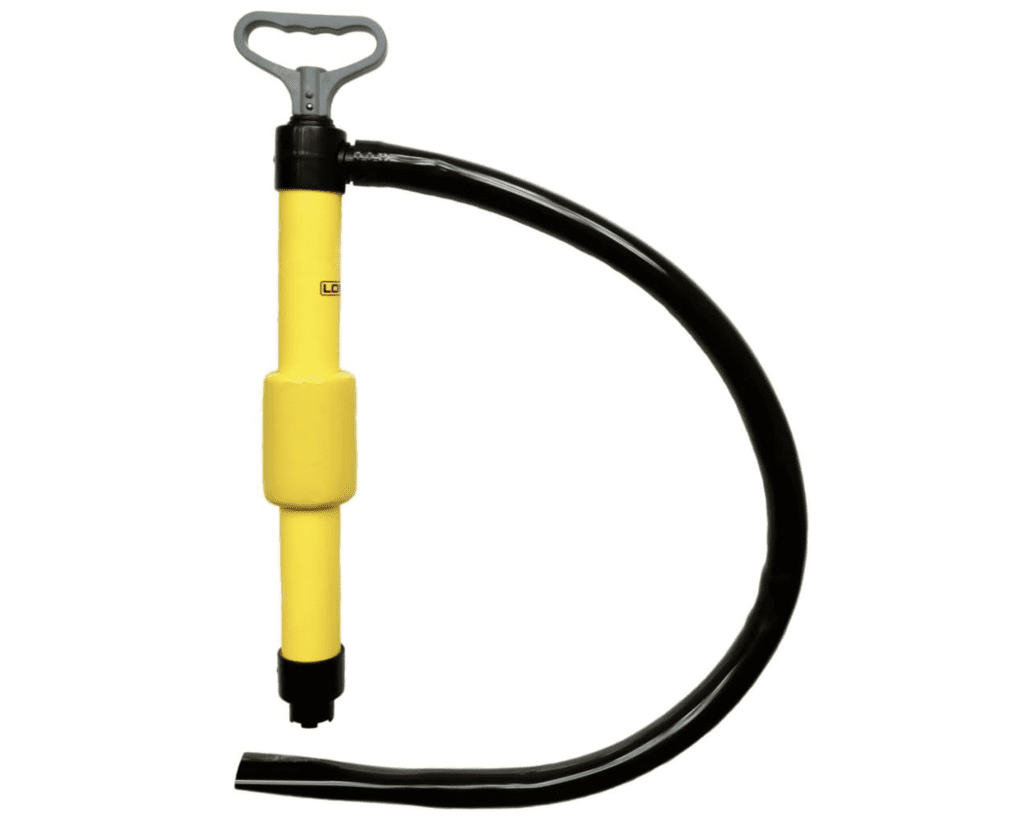
Bilge Pump
We find bilge pumps to be extremely useful at bailing out water which has splashed into the cockpit of the kayak.
Securing your items
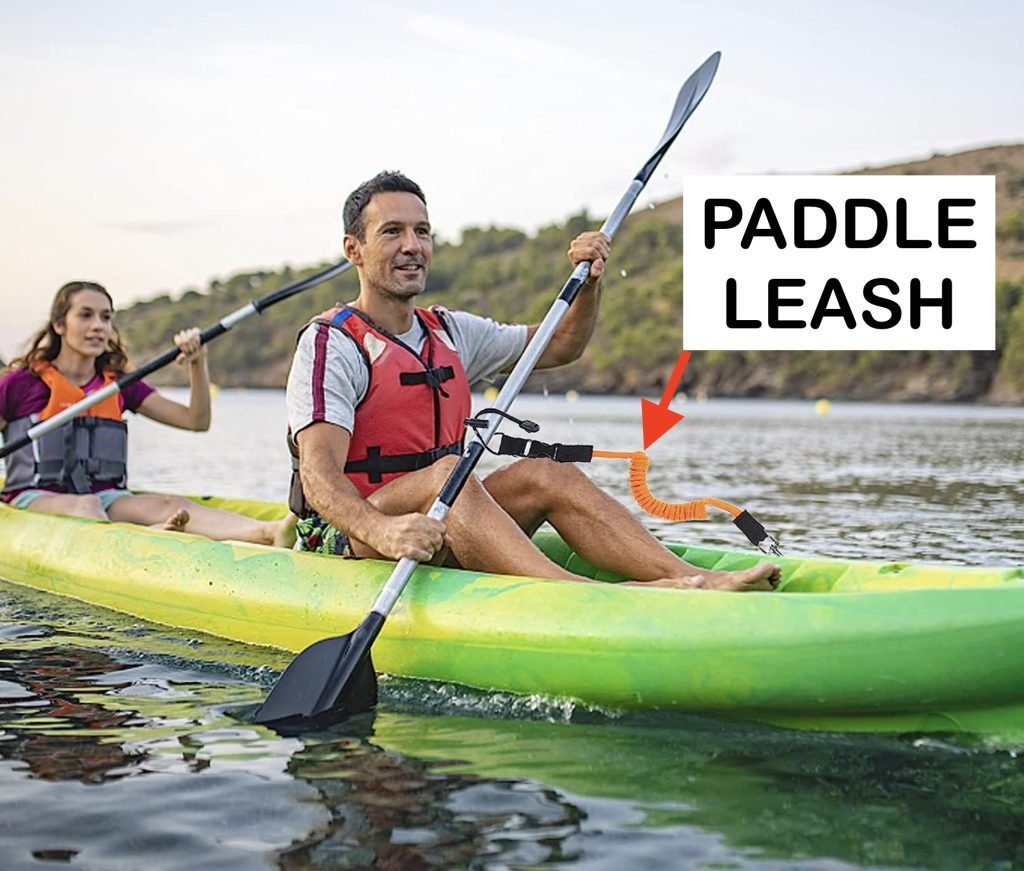
We always secure our paddles to our kayaks using paddle leash to since if you lose your paddle overboard then it can be swept down river.
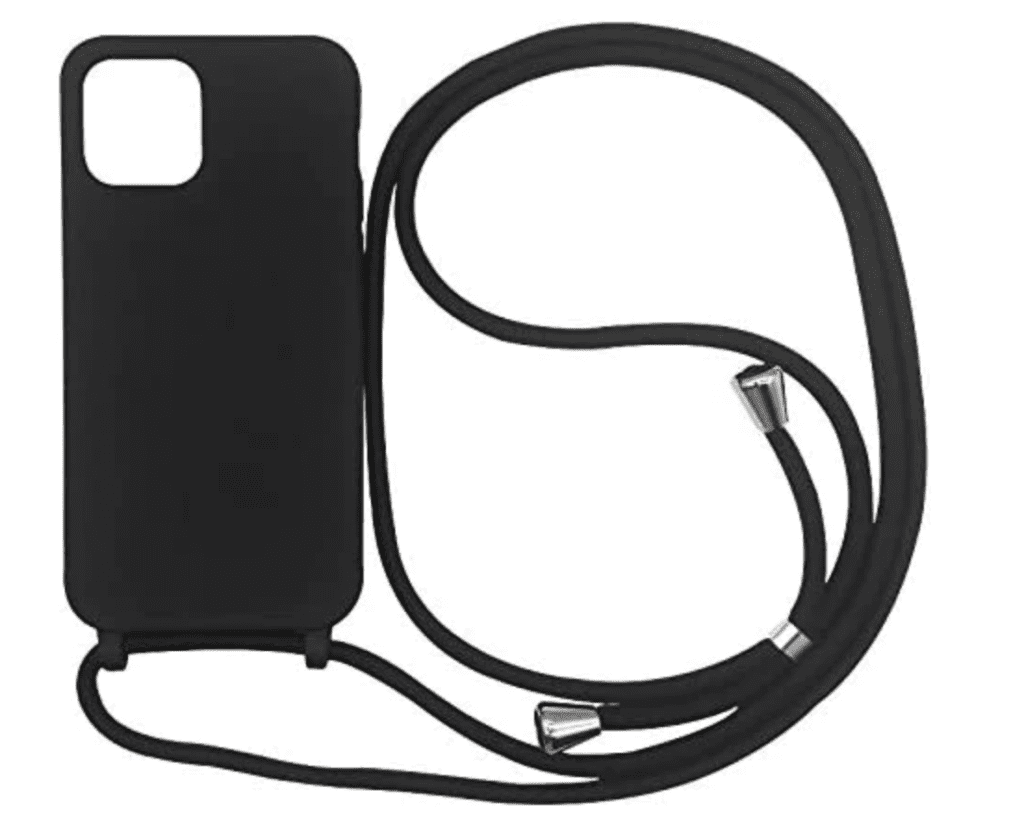
On the subject of securing your items, we keep our phones in lanyard cases when out on the water to avoid us potentially dropping them in the water.
Always remember to secure any bags down to the kayak either using the built in bungee straps that most kayaks have on their decks or by otherwise tethering them to the kayak.
11. SUMMARY
River kayaking can provide some of the best paddling you can experience.
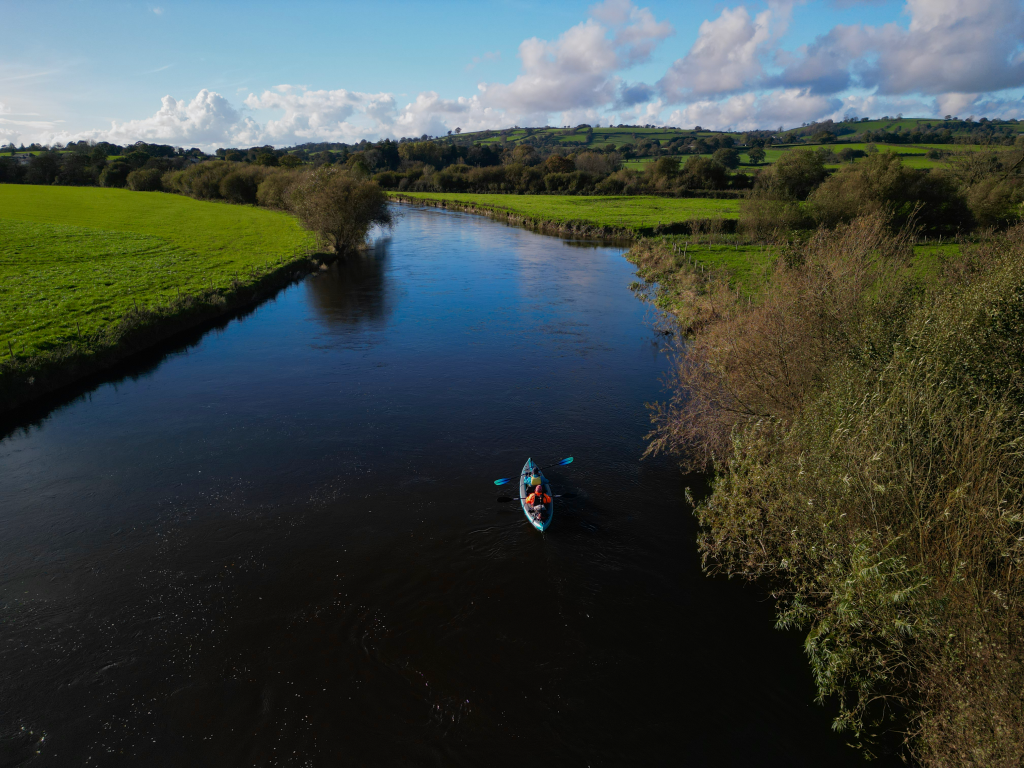
Different types of river kayaking can suite all tastes, from extreme white water paddling to flat water cruising.
We hope that you find these tips useful and they help you with your river kayaking.
Below is the link to our Youtube video of our River Kayaking Top 10 Tips.
How important is choosing the right kayak for river kayaking, and what are the key factors to consider?
Unless you are going to be white water kayaking on rapids graded 2 or above, you can use pretty much any type of kayak for river paddling.